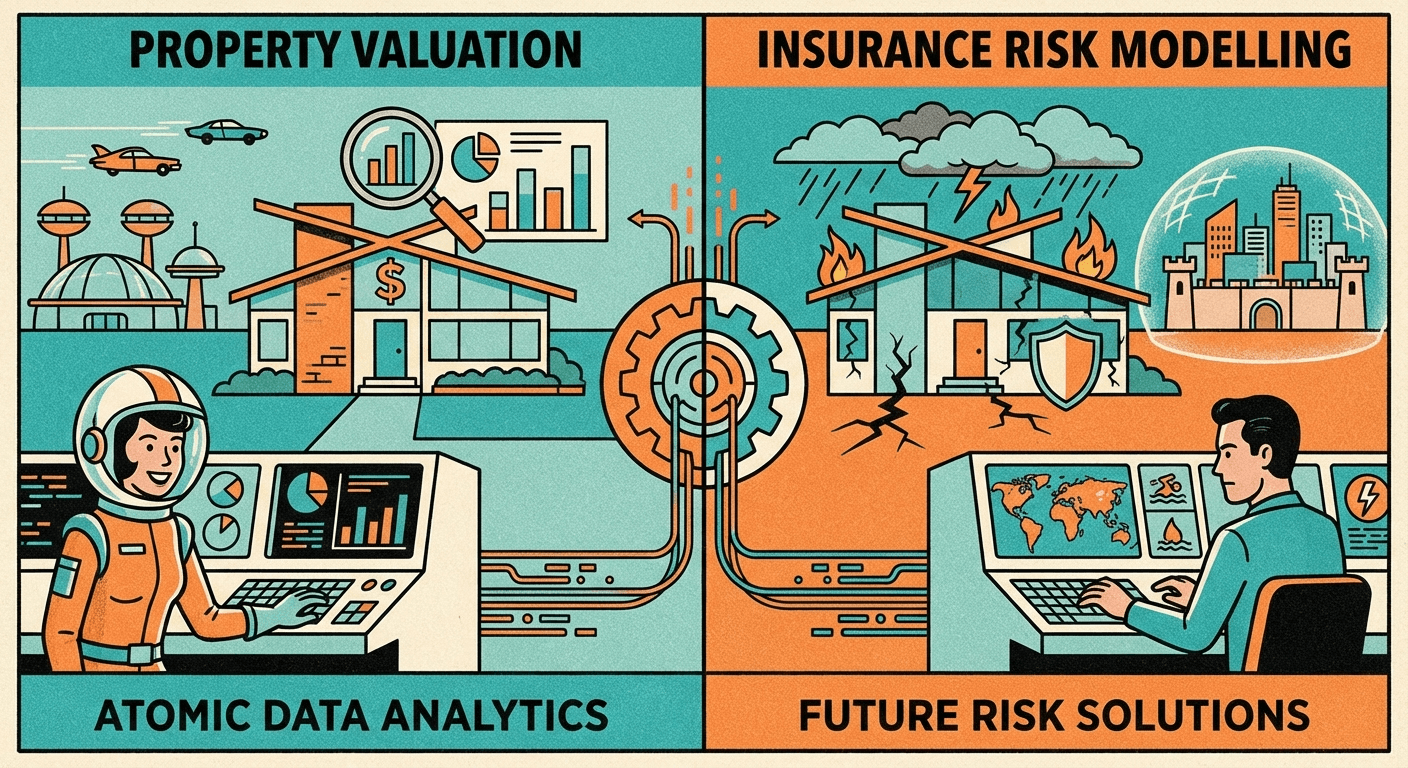
Hometrack and Verisk are both established players in UK property data, but they serve different industries. Hometrack is built around mortgage lending - its AVM and decisioning platform sit at the centre of UK mortgage origination. Verisk's UK operation is rooted in insurance - building characteristics, peril modelling, and claims estimation for the general insurance market.
This comparison is for data and procurement teams evaluating which platform covers their requirements, and where the gaps between them create opportunities to look elsewhere.
Who is Hometrack?
Hometrack was founded in 1999 and is part of the Houseful group, which also includes Zoopla, Alto, and Primelocation. Silver Lake Partners acquired the parent group for approximately £2.2 billion in 2018, having bought Hometrack the previous year for £120 million.
The company operates the UK's most widely used AVM, processing over 50 million valuations per year for 18 of the top 20 mortgage lenders. It is the only UK AVM accredited by all three major rating agencies - Moody's, S&P, and Fitch - a credential that matters for institutions issuing or investing in residential mortgage-backed securities. Hometrack's Property Risk Hub provides a cloud-native decisioning platform combining valuation, property risk data, configurable business rules, case management, and surveyor allocation for mortgage origination.
The company's climate change insights module covers flood, subsidence, coastal erosion, and energy efficiency, supporting Bank of England climate stress testing. Its Data Services division, launched more recently, draws on Zoopla's live listing data to provide market intelligence on supply, demand, and pricing trends.
Who is Verisk?
Verisk Analytics is a Nasdaq-listed, S&P 500 company headquartered in New Jersey with a market capitalisation of approximately $37 billion and $2.88 billion in FY2024 revenue. The UK property data operation was built primarily through the 2016 acquisition of The GeoInformation Group, a Cambridge-based geospatial company whose aerial imagery classification work became the foundation of Verisk's UK building data.
The core UK product is UKBuildings - a national database covering 29 million GB addresses with detailed building characteristics derived from high-resolution aerial imagery: building age, roof type, wall materials, floor area, number of storeys, basement presence, and listed building status. The dataset achieves 98% coverage of detailed property attributes across Great Britain plus the Belfast urban area.
Verisk's wider UK offering includes UKBuildings for Underwriting (ResInsight) with indicative rebuild costs, a Commercial Rebuild product launched in October 2025, eight distinct peril models at address level (flood, subsidence, storm, theft, fire, escape of water, freeze, accidental damage), the Data Insight Hub for API-based enrichment, Location Matters for interactive risk mapping, AddressIT for address verification, and Xactimate for property claims estimation. The company is also an official Ordnance Survey partner, and the two organisations jointly created deeper building data for Great Britain in 2024.
Feature comparison
Automated valuation vs building intelligence
This is the fundamental distinction. Hometrack answers the question "what is this property worth?" Verisk answers the question "what is this property made of?"
Hometrack's AVM is the benchmark for regulated UK mortgage lending. Rating-agency accreditation, 20-plus years of performance data, and integration with the Property Risk Hub make it the default for institutions that need formal valuation output for capital adequacy and securitisation. The newer Digital Valuer product combines the AVM with machine learning to reduce the need for physical inspections.
Verisk does not offer a property market valuation. Its rebuild cost estimation through ResInsight and Commercial Rebuild provides reinstatement values for insurance purposes - what it would cost to reconstruct the building - but this is fundamentally different from a market valuation. Organisations that need both must source them separately.
Risk and peril modelling
Verisk has the deeper offering. Its eight peril models cover flood (fluvial and coastal), subsidence (incorporating geology, vegetation, climate, and claims history), storm (72 million-plus wind speed recordings), theft, fire, escape of water (100 million-plus data records across 26 million properties), freeze, and accidental damage. These models are regularly recalibrated with the latest claims data and designed specifically for insurance pricing and underwriting.
Hometrack's risk coverage is narrower and lending-focused. Its climate change insights module covers flood, subsidence, coastal erosion, and energy efficiency - relevant for mortgage lending risk and regulatory reporting, but lacking the breadth of perils that insurance underwriters need. Hometrack does not model theft, fire, escape of water, or accidental damage risk.
Data delivery and integration
Verisk offers multiple delivery channels: real-time API via the Data Insight Hub, flat file licensing, GIS integration, batch processing, and the Location Matters portal. Named insurance clients including Hastings Direct, Hiscox, Beazley, and Aviva have integrated Verisk data directly into quoting and underwriting flows.
Hometrack's Property Risk Hub is a more tightly integrated platform - purpose-built for mortgage origination rather than general data consumption. It includes its own business rules engine, case management, and surveyor allocation. The Data Hub provides API access and CSV export, but the primary delivery model is the integrated workflow rather than standalone data feeds.
Geographic coverage
Hometrack provides UK-wide coverage through the Zoopla ecosystem and Land Registry data across England, Wales, Scotland, and Northern Ireland. Verisk's UKBuildings covers Great Britain (England, Wales, Scotland) and the Belfast urban area - it does not provide full Northern Ireland coverage. For organisations that need complete UK-wide data, this is a relevant gap in Verisk's offering.
Market intelligence
Hometrack holds a significant advantage through Zoopla. Access to real-time listing data, consumer search behaviour, and supply-demand metrics provides forward-looking market intelligence that Verisk's building and insurance data does not replicate. Verisk's Resonate geodemographic product tracks insurance uptake trends but does not provide property market intelligence.
Where Hometrack is stronger
Hometrack is the clear choice for mortgage lending and property valuation. The rating-agency-accredited AVM, integrated decisioning platform, and Zoopla market intelligence make it the default for institutions originating or managing mortgage books. If your primary requirement is answering "what is this property worth?" in a way that satisfies regulators, investors, and securitisation counterparties, Hometrack is purpose-built for it.
The Zoopla data partnership also gives Hometrack unique market intelligence capabilities. For tracking supply, demand, and pricing trends at regional and postcode level, no insurance-focused data provider can match the depth of live portal data.
Where Verisk is stronger
Verisk is the stronger platform for insurance underwriting, pricing, and claims. Its eight peril models, building characteristic data, rebuild cost estimation, and claims management tools cover the full insurance value chain. Named integrations with Hastings Direct, Hiscox, Beazley, and Aviva demonstrate deep enterprise adoption in that sector.
The Commercial Rebuild product launched in October 2025 addresses a specific market need - the estimated 46% of UK commercial properties that are underinsured. Hometrack has no equivalent offering for commercial reinstatement costs.
Verisk's Ordnance Survey partnership and the depth of its building classification data - roof type, wall materials, floor area, storeys, basement presence - provide granular physical property intelligence that Hometrack's market-value-focused datasets do not cover.
Where Chimnie fits in
Hometrack serves mortgage lenders. Verisk serves insurers. Both are enterprise platforms with bespoke pricing and extended procurement timelines. Neither offers transparent per-property pricing or self-serve API access, and neither provides a single product that spans both the valuation and building intelligence domains.
Chimnie bridges the gap. Its API returns over 500 attributes per property - covering market valuations, rebuild cost estimates, building characteristics, environmental risk, and planning permission data in a single request. Residential lookups are priced at £0.05-0.15 per property, and commercial data is available at £0.45 per property on a pay-as-you-go basis with ratecard volume discounts.
Where Hometrack's AVM is priced for selective mortgage use and Verisk's building data sits behind insurance enterprise contracts, Chimnie's free AVM with calibrated confidence intervals makes valuation accessible at any volume. Planning permission data - completing two years of national ingestion, launching imminently - adds a layer that neither Hometrack nor Verisk provides. Outbuildings are mapped and classified separately from main dwellings, and data is validated by over 150,000 consumer users on Chimnie's research platform.
For teams that need both property valuations and building intelligence without managing two enterprise supplier relationships, Chimnie's free trial offers a practical way to evaluate whether a single API can replace or supplement existing contracts.
Conclusion
Hometrack and Verisk operate in adjacent but distinct markets. Hometrack owns the mortgage valuation and lending decisioning space. Verisk owns the insurance building intelligence and peril modelling space. Choosing between them is rarely necessary because most organisations need one or the other based on their primary industry vertical.
The more practical question is whether either platform delivers everything a modern property data consumer requires. For organisations working across lending, insurance, proptech, or property services - or for teams that need flexible, per-property data access without committing to enterprise agreements - the answer increasingly involves evaluating API-first alternatives that combine valuation and building data in a single, accessible product.