
Street Data and Chimnie both offer API access to UK property data, but they've grown out of very different businesses. Street Data is the data arm of Street Group, a Manchester-based company whose core products are an estate agency CRM and a marketing platform called Spectre. Chimnie is a property data bureau built for insurers, lenders, and property services firms. The overlap is real - both will return property attributes for a given address - but the depth, breadth, and intended buyer differ in ways that matter.
Recent developments
March 2026: Street.co.uk announced a strategic integration with Moneypenny, a UK outsourced communications provider. The partnership connects Moneypenny’s call-handling and live chat services directly with Street.co.uk’s CRM, enabling estate and lettings agents to manage client communications alongside their property data workflows in one platform.
This comparison draws on publicly available product documentation, published pricing, and direct experience with both platforms. It's written to help data and procurement teams work out which one fits their needs.
Who is Street Data?
Street Group was founded in 2015 by Tom Staff and Heather Staff in Manchester. The company bootstrapped for nearly a decade before raising £3.3 million from Praetura Ventures in late 2024 - its first external funding round. The core business is Spectre, an all-in-one marketing suite used by over 4,000 estate agencies, and Street.co.uk, a CRM covering sales, lettings, property management, and client accounting.
Street Data (data.street.co.uk) is the group's API product, offering 150+ data points on 29 million addresses in England and Wales. It's updated daily and searchable by UPRN, UDPRN, address, or location. The dataset includes property type, bedrooms, tenure, EPC data, flood risk, council tax, previous sales, schools, transport links, broadband coverage, and - at the premium tier - estimated sale and rental values plus a proprietary propensity-to-sell score.
That propensity-to-sell model is worth noting. It's built on the behavioural data flowing through Spectre's 4,000-agent network and claims to improve marketing campaign effectiveness by over 300%. It's a genuine differentiator that no other UK property data API offers.
Street Group won three categories at the EA Masters 2025 awards (voted by agents), ranked second on BusinessCloud's PropTech 50, and its co-founders were named in The Times' Top 50 Most Ambitious Business Leaders. The company has earned strong credibility within the estate agency community.
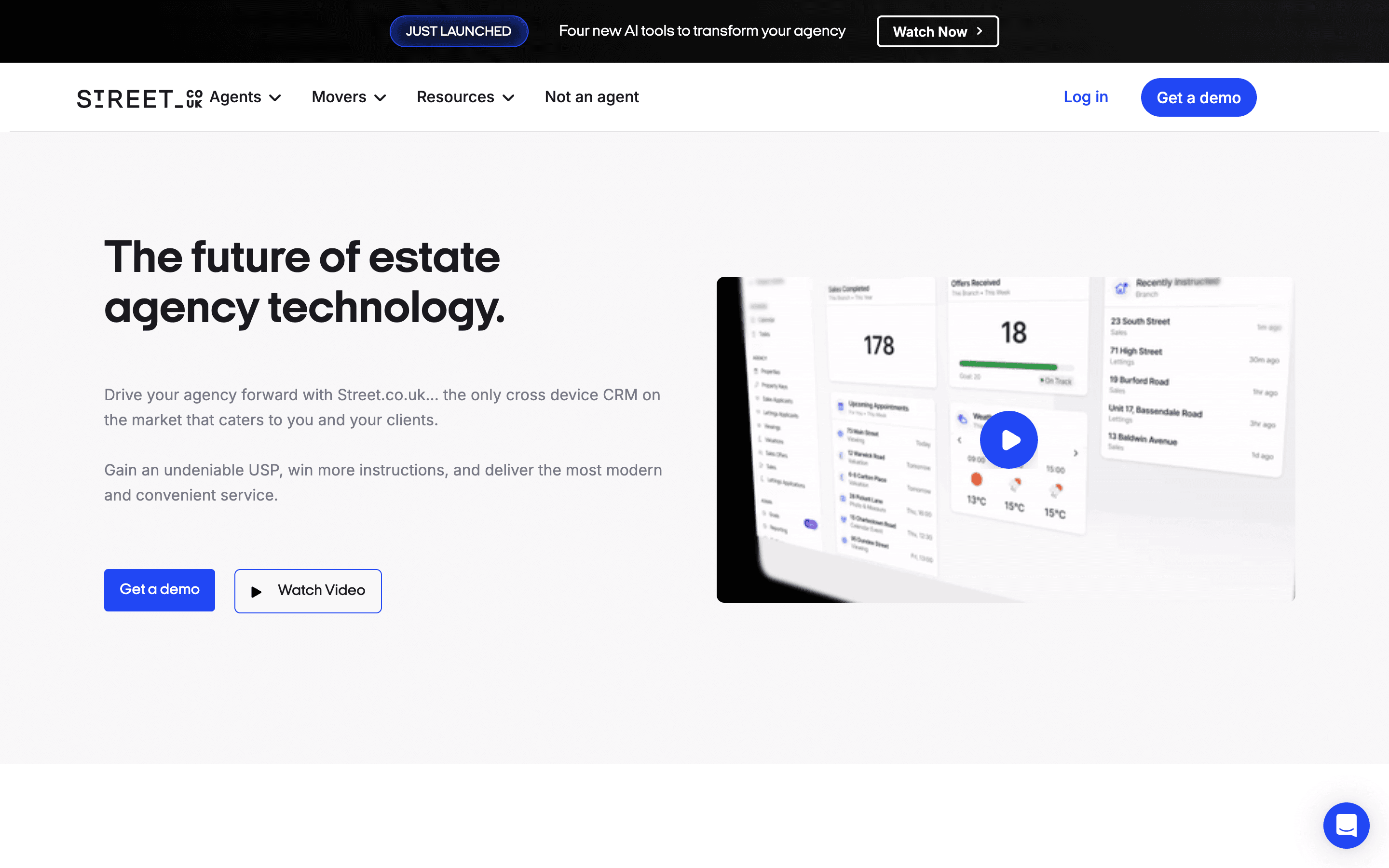
Street.co.uk estate agency software website screenshot
Who is Chimnie?
Chimnie was founded by Jon Francis, a former data scientist from Google's innovation team, with the goal of making UK property data more transparent and accessible. The company operates two platforms: chimnie.com, a B2B property data bureau serving insurers, lenders, and property services firms; and chimnie.co.uk, a free consumer research site with over 150,000 users whose feedback validates the underlying data at scale.
Chimnie processes around 30 million virtual property assessments each month, drawing on hundreds of geospatial, environmental, and proprietary datasets. Its product range includes the UK Residential Property Database, the UK Commercial Property Database, a free AVM, rebuild cost estimates, address autocomplete, risk scoring, and AI training data. Delivery is via API or flat file, with published pricing starting from less than one penny per lookup.
Feature comparison
Property data breadth
Street Data returns 150+ data points per property. Chimnie returns over 500 attributes per API call, covering structural characteristics, environmental risk, geospatial features, EPC data, ownership history, planning permissions, roof condition, outbuildings, and more. The gap isn't just numerical - Chimnie's attributes span categories that Street Data doesn't touch at all, including peril-level risk scores, satellite-derived property features, and decomposed rebuild cost data.
For teams building underwriting models or risk engines where attribute density directly affects output quality, this difference is material. For teams that need basic property facts - bedrooms, tenure, property type, EPC rating - Street Data covers the essentials at a competitive price.
Automated valuation model (AVM)
Street Data offers estimated sale values and estimated rental values at its premium tier (£0.50 per lookup), but the methodology behind these estimates isn't publicly documented in the same detail as a standalone AVM product.
Chimnie provides a free AVM built on Bayesian hierarchical methods with calibrated confidence intervals. It produces separate listing and sale price estimates at micro-postcode granularity rather than the local authority level most providers use. UPRN-based lookups cost nothing. For organisations that want to run a valuation on every case rather than reserving it for high-value exceptions, the economics are different from paying £0.50 per premium lookup.
Planning permission data
Chimnie is completing a two-year national ingestion of planning permission data from every UK local authority, standardised into a consistent schema. This dataset is launching imminently and will be the only full UK planning permission dataset available from a single provider. It accounts for extensions, conversions, and outbuildings that haven't yet triggered a new transaction or EPC - the kind of property changes that create blind spots in valuation and risk models.
Street Data doesn't include planning permission data in its current API offering.
Propensity to sell
This is Street Data's home ground. The model draws on behavioural signals from 4,000+ estate agencies and predicts when a property owner is likely to list. It's available at the premium tier and is a genuine competitive advantage for anyone in marketing, lead generation, or prospecting within the property sector. Chimnie doesn't offer anything equivalent. If your business depends on identifying potential sellers before they list, Street Data has built something unique here.
Rebuild cost estimates
Chimnie provides rebuild cost estimates with confidence intervals, finish-quality segmentation, and decomposed materials and labour breakdowns at regional level. This is a core product for insurance underwriting and claims validation. Street Data doesn't offer rebuild cost data.
Risk and environmental data
Chimnie covers flood, subsidence, crime, pollution, traffic, energy performance, roof condition (via satellite imagery and machine learning), tree-fall risk, solar panel detection, garden boundaries, and listed building status. Street Data includes some environmental data - flood risk, broadband and mobile coverage, airport noise, coastal erosion, and nearby transport - but the depth and breadth of risk signals don't match what Chimnie offers. For insurance pricing or climate exposure assessment, Chimnie's dataset is built for the job.
Commercial property data
data
Chimnie operates a dedicated UK Commercial Property Database covering offices, retail, warehouses, and mixed-use properties. Street Data covers residential addresses only. If your portfolio or client base includes commercial property, Street Data won't help.
Coverage
Street Data covers 29 million addresses in England and Wales. Chimnie's residential database covers England, Wales, and Scotland. For organisations operating across the whole of Great Britain, the Scottish coverage gap in Street Data's offering may matter.
API design and documentation
Both platforms are API-first, which is worth noting - many competitors in this space still rely on dashboard-only access or managed data feeds. Street Data provides a well-documented REST API with a £50 free credit on signup. Chimnie offers a free AVM endpoint, free address autocomplete, and full API documentation available without a sales call. Both make it straightforward to evaluate before committing.
Pricing and access
Street Data uses a three-tier model: Basic at £0.02 per property (address and identifiers), Core at £0.10 (property details, EPC, flood, sales history), and Premium at £0.50 (valuations, propensity to sell, restrictive covenants, and more). Pay-as-you-go, no subscription, £50 free credit. It's clean and transparent.
Chimnie's residential pricing runs at £0.05 per property for Core, £0.10 for Plus, and £0.15 for Premium - with all 500+ attributes available at the top tier. Commercial lookups are £0.45 per property on PAYG, with ratecard volume discounts available. The full pricing is published openly.
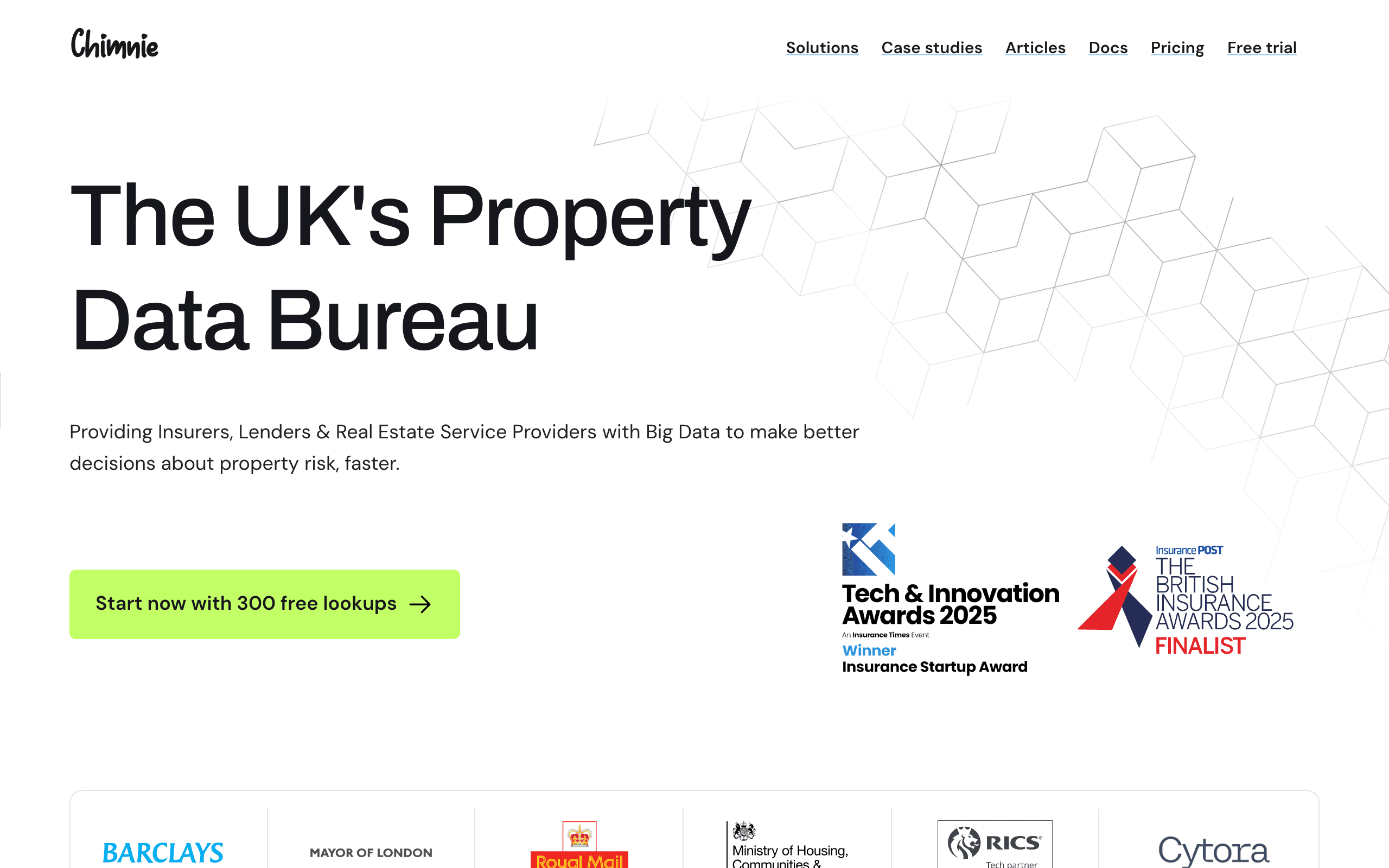
Chimnie property data API homepage
At the premium tier, Chimnie returns over three times as many attributes as Street Data for less than a third of the per-lookup cost. At the basic and core tiers, Street Data is cheaper for simpler use cases where fewer attributes will do.
AI training data
Chimnie offers over one billion property images for AI model training, alongside structured property datasets built for machine learning applications. Street Data doesn't offer training data products.
Where Street Data is stronger
Street Data wins on estate agent ecosystem integration. If you're building products for or alongside estate agencies, the Spectre platform's 4,000-agent network and the CRM's real-time data feeds create a closed loop that Chimnie doesn't replicate. The propensity-to-sell model is a direct product of this network and isn't something you can get elsewhere.
For simple property lookups where you need the basics - address details, bedrooms, tenure, council tax band - Street Data's Basic tier at £0.02 per lookup is hard to beat on price. The daily refresh cycle and the £50 free credit make it easy to test.
Street Data also has a cleaner story for one specific use case: marketing to people who are about to move. The combination of on-market listings data, propensity scoring, and the Spectre direct-mail infrastructure means you can go from data to campaign without stitching together multiple vendors.
The bootstrapped discipline behind Street Group is worth respecting too. Building a profitable, sustainable business before taking external funding says something about the product-market fit and the team's ability to execute.
Where Chimnie is stronger
Chimnie is the stronger choice when data depth, risk modelling, or insurance use cases drive the decision.
For insurance - underwriting, pricing, claims validation, fraud detection - Chimnie's data is purpose-built. Rebuild cost estimates with confidence intervals, risk scoring across dozens of perils, and pre-fill APIs are all designed around insurance workflows. Street Data doesn't serve this market.
For mortgage brokers and sourcing platforms, Chimnie's free AVM makes it practical to run a valuation on every case. The planning data (launching imminently) will add property-level intelligence that addresses post-Covid valuation gaps - where properties have been extended or converted without formal revaluation.
At the premium tier, the value-per-penny comparison favours Chimnie heavily. Over 500 attributes at £0.15 versus 150+ at £0.50 is a straightforward calculation for any team running high-volume enrichment. The commercial property database fills a gap that Street Data doesn't attempt.
Chimnie's consumer platform (chimnie.co.uk) - with over 150,000 users - creates a feedback loop that continuously validates the underlying data against real homeowner input. When homeowners check their own property details and flag inaccuracies, the data improves. Street Data's validation comes from agent activity, which is strong for listed properties but doesn't cover the broader housing stock in the same way.
For organisations that need to move quickly, Chimnie offers a free AVM, free address autocomplete, and full API documentation - no sales call required to start evaluating.
Who should choose which
Estate agents and marketing teams targeting homemovers should look at Street Data first. The Spectre integration, propensity-to-sell model, and agent network are purpose-built for this audience. Chimnie's data is richer per property, but it isn't packaged for agent marketing workflows.
Insurers, MGAs, and reinsurers should choose Chimnie. The risk scoring, rebuild cost estimates, AVM, and API delivery are built around insurance underwriting and pricing workflows. Street Data doesn't serve this market.
Mortgage lenders and brokers will find Chimnie's AVM, property attributes, and risk data more relevant to lending decisions. Street Data's estimated values are useful for screening but lack the methodological transparency and confidence intervals that regulated lending workflows tend to require.
Proptech firms and data science teams building property-related products should compare both APIs on attribute depth and pricing. For simple enrichment with basic property attributes, Street Data's lower tiers are competitive. For complex models that need hundreds of features, environmental risk data, or commercial property coverage, Chimnie is the more complete option.
Property services and asset management firms with mixed residential and commercial portfolios will need Chimnie for the commercial side. Street Data can supplement with propensity scoring and on-market listings intelligence where that's relevant.
Conclusion
Street Data and Chimnie are both transparent, API-first property data providers - a welcome contrast to the opaque pricing and sales-call-first approach that still characterises much of the UK property data market. They deserve to be compared because the product surfaces look similar, even though the underlying businesses and data depth are quite different.
Street Data is at its best when the question is about people and properties together - who's likely to sell, what's on the market, and how to reach them. Chimnie is at its best when the question is about properties alone - what's the risk, what's the value, what's the rebuild cost, and what planning history exists.
For many organisations, the decision will come down to use case rather than a general assessment of quality. Both platforms publish their pricing and let you test before committing, which means the evaluation itself shouldn't take long. Chimnie's pricing is published, the free AVM is live, and the API documentation is open - so working out whether it fits your needs takes minutes rather than months.