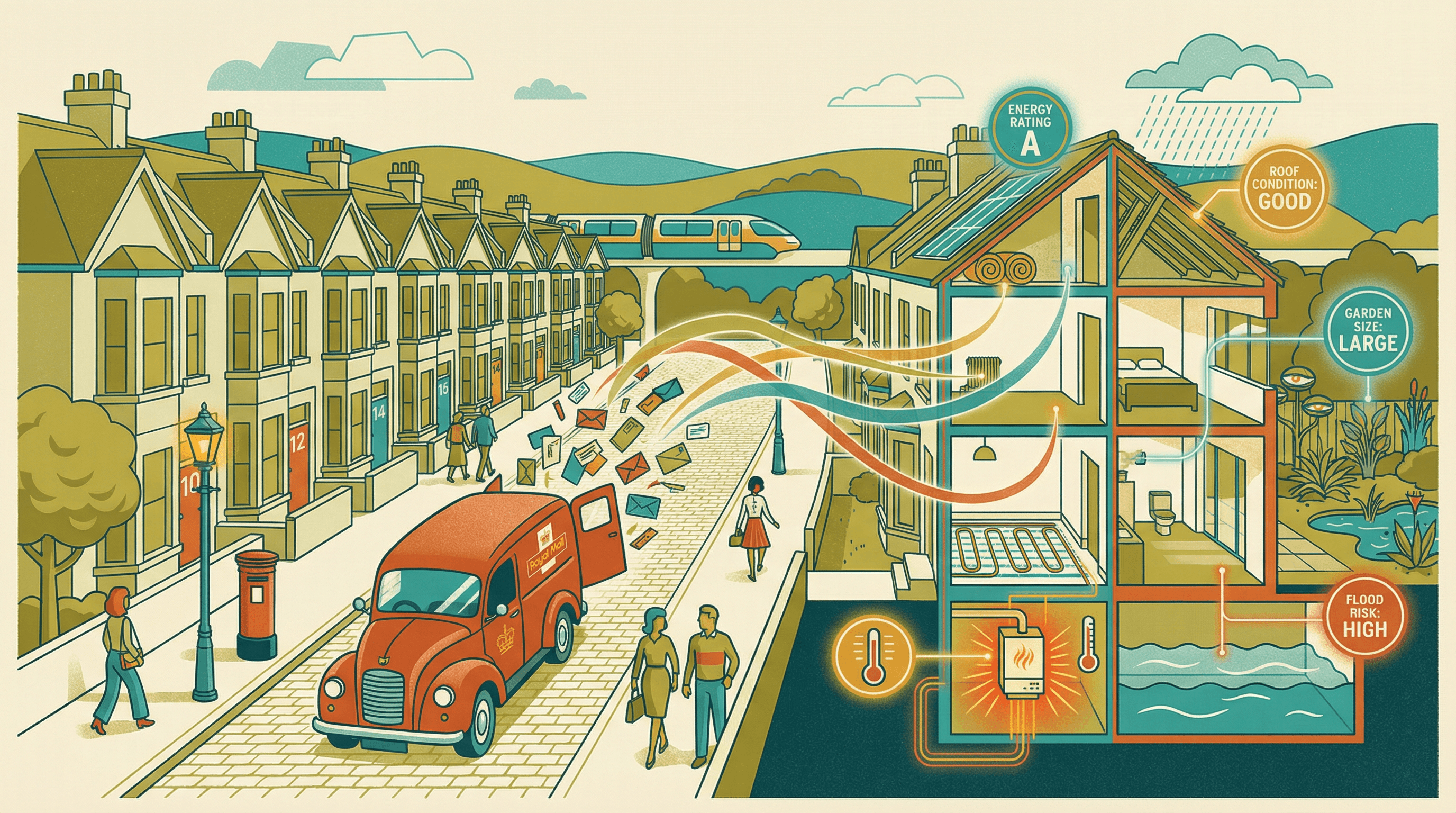
Chimnie and Royal Mail's Postcode Address File serve different purposes in the UK property data chain, and it's worth being clear about that upfront. PAF is a foundational address dataset - it's the definitive record of UK postal addresses maintained by Royal Mail. Chimnie uses PAF data as part of its address infrastructure but adds a deep layer of property intelligence on top. Comparing them directly is a bit like comparing a map to a surveyor's report - they serve different jobs, but you might need both.
This article explains what PAF delivers, what Chimnie adds beyond it, and which type of buyer needs which.
What is Royal Mail PAF?
The Postcode Address File is the UK's most widely used address dataset. Maintained by Royal Mail under obligations set out in the Postal Services Act 2000, it contains around 31 million delivery point addresses across the UK, each linked to a postcode, locality, and Royal Mail delivery route.
PAF is the backbone of address lookup in the UK. When you type a postcode into a website and see a list of addresses appear, the data behind that dropdown almost always comes from PAF (either directly or via a licensed reseller). It's updated daily, reflecting new builds, demolitions, and postal changes reported to Royal Mail.
PAF is not accessed directly by most businesses. Instead, Royal Mail licenses the data to solution providers - companies like Ideal Postcodes, Postcoder, Loqate, and others - who wrap it in APIs and sell access per lookup. Businesses can also license PAF directly from Royal Mail, though the licensing structure is complex. There are separate agreements for solution providers, direct end users, corporates, microbusinesses, and charities. Pricing varies by organisation type and usage model (per user, per transaction, or unlimited website use), and it isn't published in a simple per-lookup format.
What PAF contains is deliberately limited. Each record has an address (building number/name, thoroughfare, locality, post town, postcode), a delivery point suffix, and some basic classification. It does not include coordinates, UPRNs, property attributes, or any information about the property beyond its postal address.
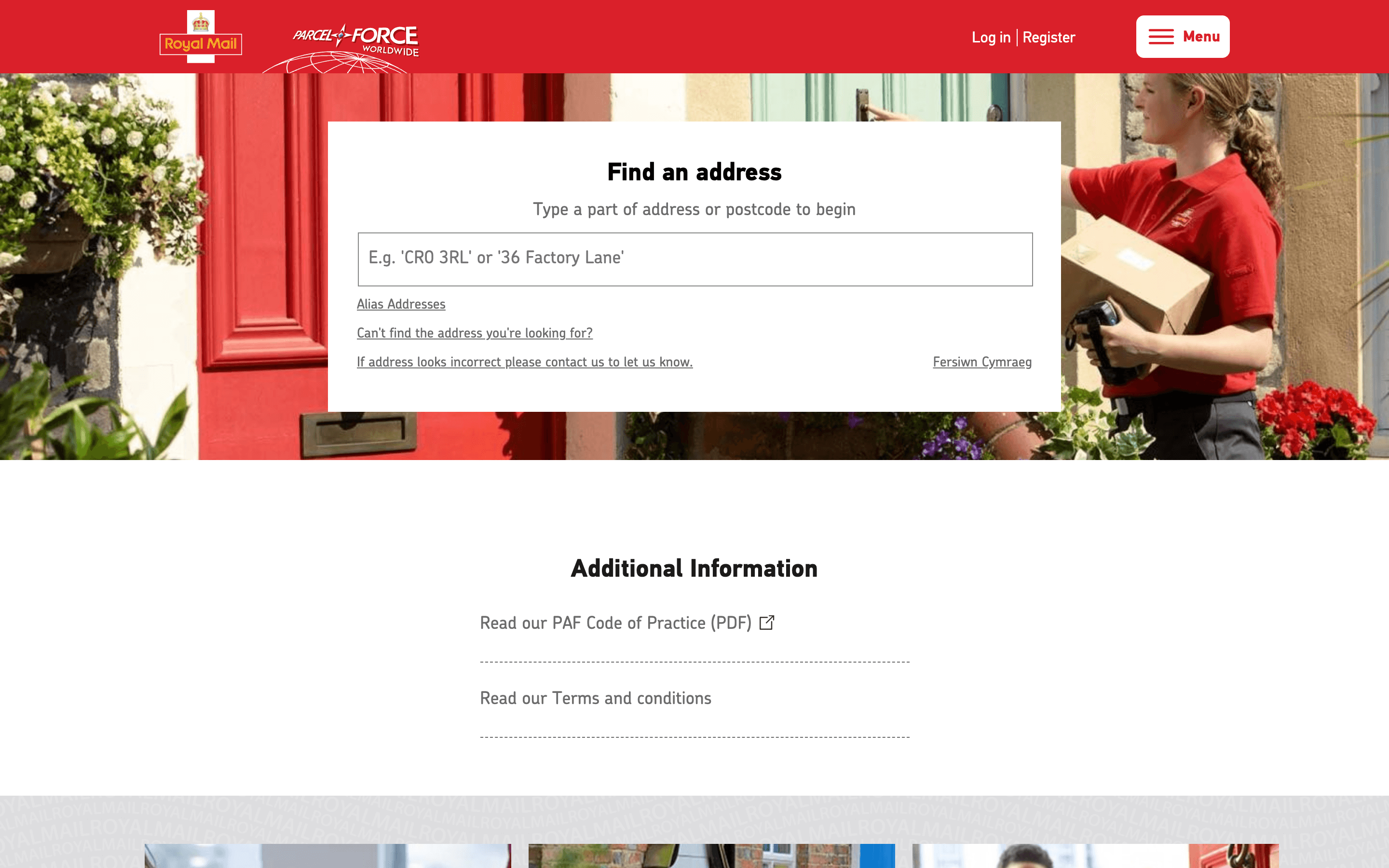
Royal Mail PAF Postcode Finder website screenshot
What is Chimnie?
Chimnie was founded by Jon Francis, formerly of Google's innovation team, to make UK property data more accessible. The company operates chimnie.com as a B2B property data bureau for insurers, lenders, and proptech firms, and chimnie.co.uk as a free consumer property research platform with over 150,000 users.
Chimnie uses PAF (and Ordnance Survey data) as part of its address lookup infrastructure, then layers over 500 property attributes on top. A single API call returns the validated address plus EPC data, flood risk, subsidence indicators, conservation area status, listed building flags, rebuild cost estimates, automated valuations, planning permissions, structural characteristics, satellite-derived features, and more.
Pricing is published: residential lookups from £0.05 to £0.15 per property, commercial at £0.45, with volume discounts through a ratecard.
What PAF gives you versus what Chimnie gives you
Address lookup
PAF is the source. When Chimnie (or any other UK address provider) returns a list of addresses for a postcode, the underlying address records typically trace back to PAF. Royal Mail's daily updates mean new addresses are reflected quickly, and the postcode structure is the standard that the UK postal system and most address-dependent workflows are built around.
On its own, PAF tells you: this address exists, it belongs to this postcode, and this is how Royal Mail formats it. That's valuable - accurate addressing reduces failed deliveries, improves data quality, and helps match records across systems. But it stops at the front door.
Property intelligence
Chimnie starts at the front door and goes inside. For the same address, a Chimnie API call returns:
- Energy performance data (current and potential ratings, heating type, wall construction, roof insulation) - Flood risk from multiple sources (rivers, surface water, coastal) - Subsidence risk indicators - Conservation area and listed building status - Rebuild cost estimates with confidence intervals and finish-quality breakdowns - Automated valuations with separate listing and sale price models - Planning permission data (completing a two-year national ingestion, launching imminently) - Satellite-derived features (roof condition, solar panels, garden boundaries) - Structural characteristics and property type classification
PAF contains none of this. It was never designed to. The Postcode Address File is an address dataset, not a property intelligence product.
Geocoding
PAF does not include geographic coordinates. The address records have postcodes, which can be mapped to approximate locations via the Office for National Statistics postcode directory, but property-level geocoding requires Ordnance Survey data (AddressBase includes coordinates and UPRNs). Chimnie includes coordinates and UPRN-based lookups as standard.
Licensing differences
PAF licensing is notoriously complex. Royal Mail's licensing structure includes separate agreements for solution providers, direct end users, corporates, microbusinesses, and charities. Usage can be licensed per named user, per transaction, or as unlimited website use. Solution providers who resell PAF-based lookup services pay licence fees back to Royal Mail, and those fees are passed on to their customers.
The practical effect is that PAF licensing adds a cost layer to every address lookup in the UK. When you pay a reseller 2p to 5p per address lookup, a portion of that goes to Royal Mail as a PAF licence fee. This is a sunk cost for any UK address-based service.
Chimnie's licensing is straightforward. Published PAYG pricing, no minimum commitments, and the PAF/OS licensing costs are absorbed within Chimnie's per-lookup price. You don't need a separate PAF licence to use Chimnie's API - the addressing layer is included.
Where PAF is essential
PAF is the foundation. Without it (or its Ordnance Survey equivalent, AddressBase), there is no reliable way to resolve UK postcodes to individual addresses. Every serious address lookup service in the UK depends on PAF data, either directly or through OS AddressBase which incorporates PAF records.
If your sole requirement is address validation - confirming that an address exists, standardising its format, and matching it to a postcode - then PAF via a licensed reseller is all you need. For checkout forms, CRM data cleansing, mailing list validation, and delivery routing, PAF does the job.
Royal Mail's daily update cycle also means PAF captures new-build addresses faster than some other sources, which matters for businesses that need to serve customers at newly constructed properties.
Where Chimnie adds value on top
For any use case that needs to know something about the property at that address - not just that the address exists - Chimnie is where the value sits.
Insurance underwriting needs flood risk, subsidence, rebuild costs, property type, and construction details. Mortgage lending needs valuations, EPC data, and property condition indicators. Property analytics needs planning history, structural attributes, and environmental scoring. None of this comes from PAF.
Chimnie's single-API approach means you don't need to query PAF (via a reseller) for the address, then separately call an EPC provider, a flood data provider, a valuation provider, and a rebuild cost provider. One call to Chimnie returns the address - resolved using PAF and OS data under the hood - plus everything else. That's simpler to integrate, cheaper per property, and easier to maintain.
The free AVM is worth highlighting. UPRN-based property valuations at zero cost, with separate listing and sale price models, are not something PAF or any PAF reseller can offer. For businesses that need a property value alongside the address - mortgage brokers, insurers, portfolio managers - this saves both money and integration effort.
The consumer platform at chimnie.co.uk provides a data quality feedback loop. Over 150,000 users checking their own property data means real homeowners validating and correcting records, which improves the underlying dataset in ways that purely administrative sources like PAF don't support.

Chimnie website homepage screenshot
Who should choose which
If your need is address validation and nothing more - standard checkout autocomplete, mailing list cleansing, CRM standardisation - use a PAF reseller. Ideal Postcodes, Postcoder, Loqate, and others all offer PAF-based lookup at competitive per-transaction prices, typically 2p to 5p per call.
If your need extends to property intelligence - risk data, valuations, rebuild costs, EPC, planning, structural attributes - use Chimnie. The addressing layer (including PAF data) is built in, so you don't need a separate PAF integration. One API, one contract, one set of documentation.
For businesses already using a PAF reseller for checkout autocomplete but needing property data elsewhere in their workflow (underwriting, risk, analytics), adding Chimnie alongside the existing address provider is straightforward. There's no conflict - PAF handles the front-end address capture, Chimnie handles the back-end property enrichment.
Conclusion
Royal Mail PAF is the UK's foundational address dataset, and its role in address validation is not going away. Chimnie uses PAF as part of its addressing infrastructure but serves a fundamentally different purpose: turning addresses into property intelligence. For address lookup alone, PAF via a reseller is efficient and well understood. For anything that needs property data alongside the address, Chimnie replaces the need to stitch together multiple providers by bundling addressing and property intelligence into a single API call.