
Chimnie and PropertyData both help people make decisions about UK property, but they do it in different ways for different audiences. PropertyData is a self-service analytics tool built for property investors, developers, and deal sourcers. Chimnie is a property data API built for insurers, lenders, and technology firms who need structured data at scale.
This comparison draws on publicly available product information and pricing. It's written to help potential buyers understand which platform fits their use case.
Who is PropertyData?
PropertyData is a subscription-based analytics platform aimed at property investors, developers, estate agents, and deal sourcers. The platform aggregates data from Rightmove, Zoopla, OnTheMarket, SpareRoom, Land Registry, and MHCLG (EPC data) to provide market analytics at the postcode and local authority level.
The product includes tools for postcode-level analytics (asking prices, sold prices, rental yields, days on market, price per square foot), property sourcing filters (unmodernised, cash buyers only, auction, repossessed, HMO licensed, planning potential), comparables for both sales and rentals, construction cost estimates, and an API for programmatic access.
PropertyData is well-reviewed - 4.6 out of 5 on Reviews.io from 324 reviews - and has built a loyal following among individual investors and small property businesses. The platform has a browser extension that overlays data onto property portal listings, which is popular with sourcers.
Pricing starts at £28 per month after a 14-day free trial, with plans scaling based on API credits and feature access. Annual subscriptions give one month free. API credits are consumed per endpoint call, with some endpoints costing more than one credit.
PropertyData covers the whole of the UK, which is a genuine advantage - many analytics platforms restrict coverage to England and Wales only.
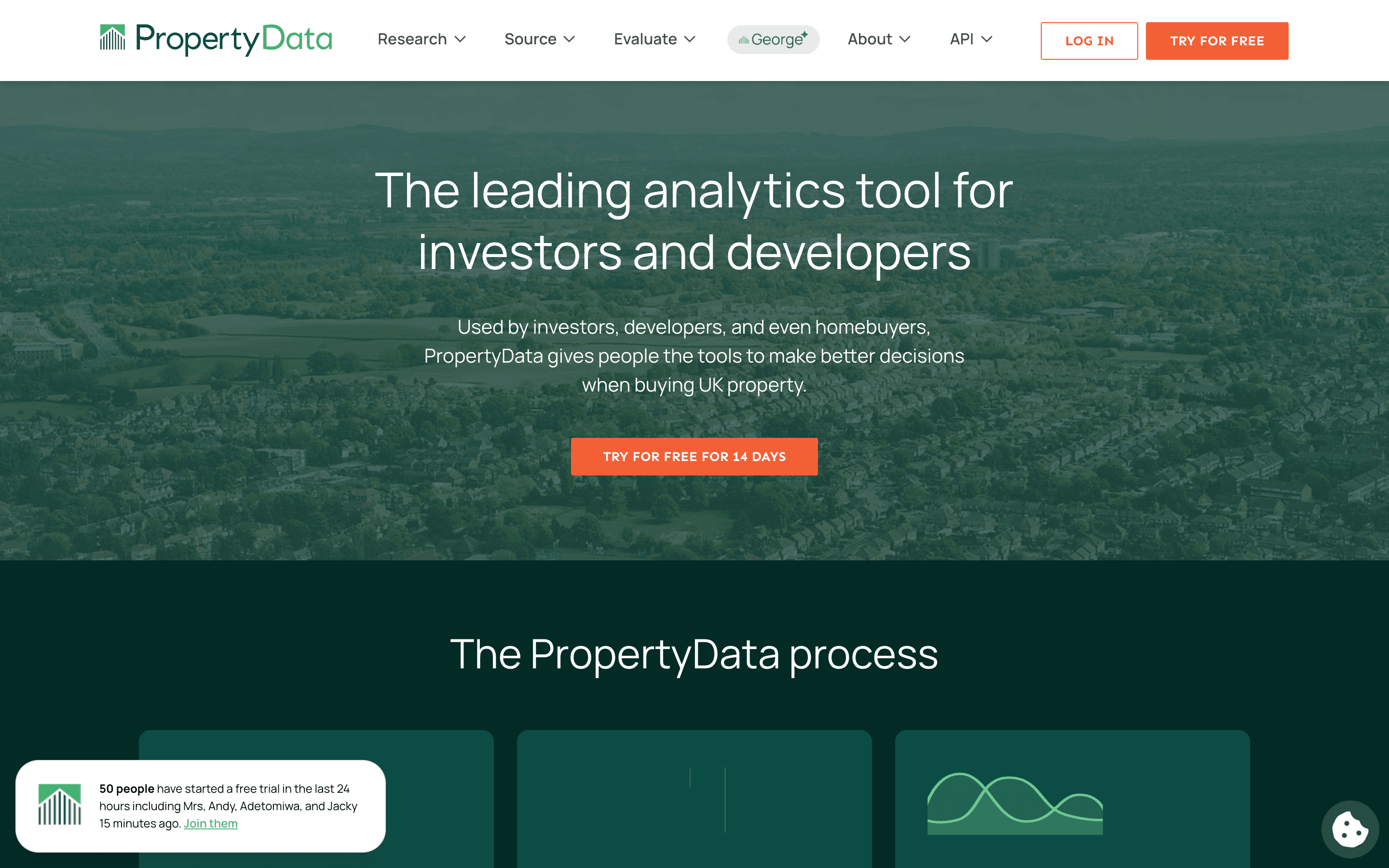
PropertyData property market analytics website screenshot
Who is Chimnie?
Chimnie was founded by Jon Francis, a former data scientist from Google's innovation team, with the goal of making UK property data more transparent and accessible. The platform covers 35 million-plus UK residential properties and returns over 500 attributes per property through a documented REST API.
Chimnie processes around 30 million virtual property assessments each month, drawing on hundreds of geospatial, environmental, and proprietary datasets. Its commercial API starts at £0.45 per property on a pay-as-you-go basis, with ratecard volume discounts available. Residential lookups are priced from £0.05 to £0.15 per property.
The consumer platform at chimnie.co.uk serves over 150,000 users researching their own properties, creating a feedback loop that improves data quality over time.
Feature comparison
Market analytics and sourcing
PropertyData's strength is market-level analytics for investors. The platform answers questions like "what's the average yield in this postcode," "which properties are priced below market," and "how long are properties sitting on the market in this area." The sourcing filters - unmodernised, cash buyers only, auction, repossessed, HMO licensed - are specifically designed for deal sourcers and investors looking for below-market opportunities.
Chimnie doesn't offer property sourcing or listing-based analytics. Its data starts at the property level rather than the market level.
Property-level data
Chimnie returns 500-plus attributes for an individual UPRN - EPC, flood risk, subsidence, pollution, crime, listed building status, conservation areas, roof condition (satellite-detected), outbuilding mapping, extensions, solar potential, and structural characteristics. This property-level detail is designed for enrichment workflows in insurance, lending, and compliance.
PropertyData provides property-level data drawn from listings and public records - asking price, sold price, square footage (estimated from floor plans), EPC rating, and Land Registry transaction history. This is useful for investment analysis but doesn't cover the physical risk and structural attributes that Chimnie returns.
Automated valuation model (AVM)
Chimnie provides a free AVM with UPRN-based lookups, running separate listing and sale price models with Bayesian methods and calibrated confidence intervals. This is designed for programmatic use in lending and insurance pricing.
PropertyData doesn't offer an AVM in the traditional sense. It provides comparables and area averages that users can use to form a view on value, but there's no single-property automated valuation with confidence scoring.
Comparables
PropertyData provides sales and rental comparables with filtering by property type, bedrooms, distance, and time period. Users can see what similar properties sold for or are listed at in a given area. This is directly useful for investment appraisals and offers.
Chimnie's AVM uses comparable data internally but doesn't expose a browsable comparables search.
Construction and rebuild costs
PropertyData offers construction cost estimates through its calculator tools, aimed at developers estimating build costs for new projects or refurbishments.
Chimnie provides rebuild cost estimates with confidence intervals, finish-quality segmentation, and decomposed materials and labour breakdowns at regional level. These are designed for insurance reinstatement purposes rather than development appraisals, so the models are different in scope and methodology.
Planning data
PropertyData shows planning history for individual properties and areas, drawn from public records.
Chimnie is completing two years of national planning permission ingestion from every UK local authority, standardised into a consistent schema for API delivery. The depth and standardisation of this dataset is designed for bulk enrichment rather than individual property research.
Risk and environmental data
Chimnie covers flood, subsidence, crime, pollution, traffic, energy performance, roof condition, tree-fall risk, and solar potential. These risk signals are core to insurance and lending use cases.
PropertyData doesn't cover environmental or physical risk data beyond what's available in EPC certificates.
Pricing and access
PropertyData starts at £28 per month with a 14-day free trial. Plans scale with API credits. Annual subscriptions offer one month free. This is transparent and accessible pricing for individual users and small teams.
Chimnie's commercial lookups cost £0.45 per property PAYG, with ratecard volume discounts. Residential tiers run from £0.05 to £0.15 per property. The API documentation is open and free to explore.
The pricing models reflect different use cases. PropertyData's subscription gives unlimited browsing of its analytics dashboard with API credits for programmatic access. Chimnie's per-lookup model is designed for transactional enrichment workflows.
For an individual investor researching 20 to 30 properties a month, PropertyData at £28 is better value. For a technology firm enriching thousands of properties a day through an automated pipeline, Chimnie's per-lookup pricing is more scalable.
Where PropertyData is stronger
PropertyData wins for property investors and deal sourcers. The sourcing filters, yield calculators, area analytics, and comparables tools are built specifically for finding and evaluating investment opportunities. No one building an investment portfolio needs 500 property attributes - they need to know the yield, the comparables, and whether the price is right.
The browser extension that overlays data onto Rightmove and Zoopla listings is a practical time-saver that Chimnie doesn't offer.
PropertyData's £28 starting price is genuinely accessible. For a sole trader investor or a small sourcing business, it's an easy decision. Chimnie's model doesn't make economic sense for someone looking at a handful of properties per month in a dashboard.
The user reviews speak for themselves. 324 reviews at 4.6 stars suggest a product that consistently delivers value to its target market. The community around PropertyData - investors, developers, deal sourcers - creates practical knowledge sharing that a B2B API platform doesn't replicate.
PropertyData's UK-wide coverage, including Scotland and Northern Ireland for most datasets, is worth noting. Not all analytics platforms match this breadth.
Where Chimnie is stronger
Chimnie is stronger for any use case that needs structured property data delivered programmatically at scale.
For insurance underwriting, the combination of 500-plus property attributes, rebuild cost estimates with confidence intervals, and risk scoring across multiple perils fills requirements that PropertyData doesn't touch. No insurance pricing model runs on yield calculators and sourcing filters.
The free AVM is commercially significant for mortgage lenders and brokers. PropertyData doesn't offer automated valuations.
Chimnie's planning permission dataset - standardised from every UK local authority - provides a depth of planning data that PropertyData's public record summaries don't match.
For proptech firms building products, Chimnie's API is designed for integration. Structured JSON responses, bulk queries, documented endpoints, and published pricing make it practical to build on. PropertyData's API is more of an add-on to its analytics platform.
Data breadth is the fundamental difference. 500-plus attributes per property versus a focused set of investment metrics. If your workflow needs flood risk, subsidence, roof type, outbuildings, conservation area status, and rebuild costs alongside valuation data, Chimnie delivers all of that in one call.

Chimnie website homepage screenshot
Who should choose which
Property investors and deal sourcers should start with PropertyData. The analytics, sourcing tools, and comparables are purpose-built for investment decision-making at an accessible price point.
Estate agents looking for area-level market data to inform pricing advice will find PropertyData more immediately useful than Chimnie's API.
Property developers evaluating build costs and market conditions might use PropertyData for market analysis alongside other tools for detailed feasibility.
Insurers, MGAs, and reinsurers should choose Chimnie. The risk data, rebuild cost modelling, AVM, and API delivery are built for insurance workflows.
Mortgage lenders and brokers will find Chimnie's AVM and property enrichment more relevant to their needs. PropertyData's market analytics could complement this for manual review cases.
Proptech firms building property-related products need Chimnie's API. PropertyData's API credits model isn't designed for high-volume, automated enrichment pipelines.
Conclusion
PropertyData and Chimnie are built for different people solving different problems. PropertyData helps investors find and evaluate deals. Chimnie helps businesses enrich, score, and value properties at scale.
There's limited overlap between the two, and for many organisations the choice is obvious based on their use case. An investor doesn't need rebuild cost confidence intervals. An insurer doesn't need a browser extension for Rightmove.
Where the comparison gets interesting is for larger property businesses that both source deals and need to process applications. In those cases, the two products are more complementary than competitive. But for most buyers, the use case will point clearly in one direction.