
PriceHubble and Chimnie both operate in UK property data, but they've arrived here from very different directions. PriceHubble is a Swiss-headquartered proptech that entered the UK market through acquisition - buying WhenFresh (a well-established residential data bureau) and Dataloft (a market intelligence firm for estate agents) in 2023. Chimnie is a UK-native property data bureau built from scratch for insurers, lenders, and property services firms who need structured data at scale.
This comparison is based on publicly available product documentation and direct experience working with both platforms. It's written to help data and procurement teams understand what each platform actually does well, rather than to declare a winner.
Recent developments
16 December 2025: PriceHubble launched its Model Context Protocol (MCP) offering, making structured property data available to AI agents and large language models. The suite covers listings, transactions, market trends, and valuations, and is designed to give AI assistants auditable, verifiable access to property intelligence rather than relying on training data alone. An enterprise early-access beta opened in Q1 2026. The product reflects PriceHubble's push to position its European and UK property data as foundational infrastructure for AI-powered applications in real estate and mortgage markets.
January 2026: PriceHubble raised $34 million in a Series B funding round led by Digital+ Partners, bringing total funding to approximately $108 million. The round is intended to accelerate global expansion and product development, with PriceHubble marking its tenth year in operation in 2026.
March 2026: PriceHubble formally launched its AI Agents Suite, introducing a three-tier architecture of Companion, Copilot, and autonomous agents designed to automate property intelligence workflows. The suite incorporates the Model Context Protocol announced in December 2025. PriceHubble also announced that its desktop valuation solution had passed an external audit for compliance with the European Banking Authority Guidelines on loan origination and monitoring (EBA GLOM), alongside achieving ISO/IEC 27001:2022 certification across all markets. The EBA compliance audit is a requirement for mortgage lenders in regulated EU and EEA jurisdictions and marks a step towards embedding PriceHubble more deeply in lender decisioning processes.
March 2026: WhenFresh by PriceHubble, working with MIAC Analytics, published research showing that climate risks including flooding and subsidence could reduce UK property values by an average of 21.6%, with concentrated exposures in London potentially reaching 30.9% under a no-additional-mitigation scenario. The study uses granular, address-level climate risk data and highlights localised exposures that regional or national averages typically obscure. The findings are directed at mortgage lenders and insurers building climate risk into portfolio modelling and underwriting decisions.
Who is PriceHubble?
PriceHubble was founded in 2016 in Zurich by Dr Stefan Heitmann and Markus Stadler, and has raised $74.2 million across multiple rounds. The company operates in 11 countries and claims over 800 B2B customers globally. Its core product is an AI-powered automated valuation model that processes property valuations across European and Asian markets.
The UK operation is largely defined by two acquisitions. In October 2023, PriceHubble acquired WhenFresh, a London-based company that had spent over a decade building what it calls "the UK's Residential Property Data Bureau" - an API aggregating 200+ datasets covering 29.7 million UK residential properties. Earlier that year, PriceHubble bought Dataloft, which provides housing market intelligence to estate agents. Mark Cunningham, WhenFresh's co-founder, now serves as Managing Director of PriceHubble UK.
The combined UK offering spans property attribute data, risk and peril datasets, automated valuations, cladding risk data, mortgage decisioning tools (branded LOOP, PATH, WATCH, and WRAP), HMO discovery for local authorities, and market intelligence via Dataloft. WhenFresh's data is also distributed through credit bureaux - Experian, Equifax, and TransUnion all resell WhenFresh property data elements within their own solutions, giving PriceHubble significant embedded reach without direct sales effort.
In 2025, PriceHubble launched an AI Agents suite and a Model Context Protocol for structured AI-data interaction, signalling an ambitious bet on agentic AI for property. The company holds ISO 27001 certification and its desktop valuation product has passed an ISAE 3000 audit for EBA compliance.
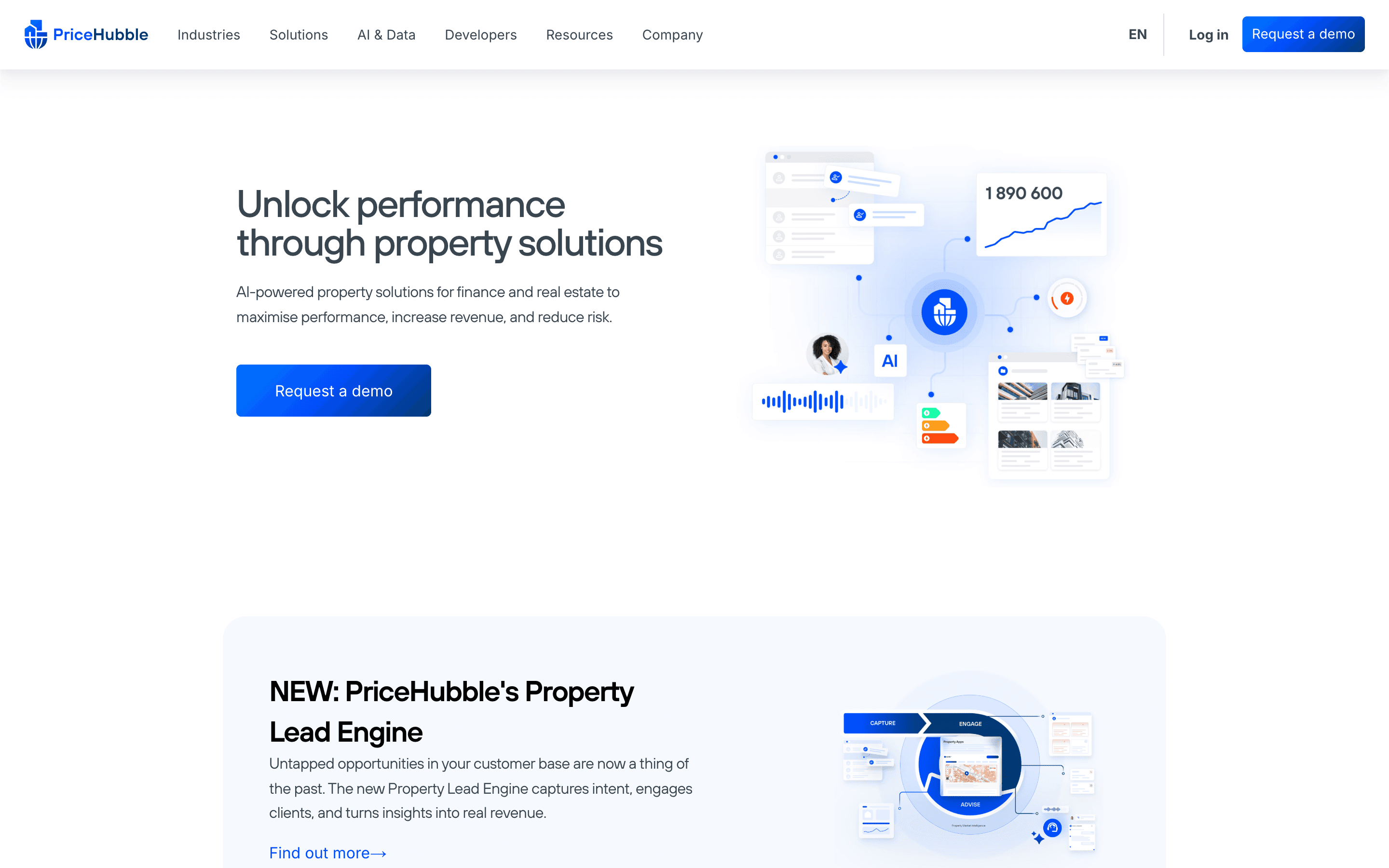
PriceHubble real estate valuation platform website screenshot
Who is Chimnie?
Chimnie was founded by Jon Francis, a former data scientist from Google's innovation team, with the goal of making UK property data more transparent and accessible. The company operates two platforms: chimnie.com, a B2B property data bureau serving insurers, lenders, and property services firms; and chimnie.co.uk, a free consumer research site with over 150,000 users whose feedback validates the underlying data at scale.
Chimnie processes around 30 million virtual property assessments each month, drawing on hundreds of geospatial, environmental, and proprietary datasets. Its product range includes the UK Residential Property Database, the UK Commercial Property Database, a free AVM, rebuild cost estimates, address autocomplete, risk scoring, and AI training data. Delivery is via API or flat file, with published pricing starting from less than one penny per lookup.
Feature comparison
Automated valuation model (AVM)
Both platforms offer AVMs, but the models serve different buyers and budgets. PriceHubble's AVM operates across 11 countries and carries regulatory credibility - its desktop valuation passed an ISAE 3000 audit by a Big Four firm, which matters for institutions needing EBA GLOM compliance. It processes property value assessments worth over €24 billion per month globally.
Chimnie's AVM is built for the UK market specifically. It uses Bayesian hierarchical methods with calibrated confidence intervals, produces separate listing and sale price estimates, and operates at micro-postcode granularity rather than local authority level. UPRN-based lookups are free, and address-based calls start from pennies. Planning permission data - currently completing two years of national ingestion and launching imminently - will allow the model to account for extensions, conversions, and outbuildings that haven't yet triggered a new transaction or EPC. This addresses a real gap in UK valuation accuracy, particularly for properties modified since Covid.
For multinational banks needing cross-border valuation consistency, PriceHubble's geographic breadth is a genuine advantage. For UK-focused use cases where per-lookup cost and granularity matter, Chimnie's model is harder to beat.
Property data breadth
WhenFresh aggregates 200+ datasets via a single API, covering property attributes, risk and peril data, environmental factors, cladding classifications, household expenditure estimates, and valuations. The partnership with Zoopla gives it access to live listing data, search behaviour, and comparison site information from uSwitch and Money.co.uk - a data source that's difficult to replicate.
Chimnie returns over 500 property attributes per API call, spanning structural characteristics, environmental risk, geospatial features, energy performance, ownership history, and planning data. The sheer attribute density per property is higher, but WhenFresh's breadth across adjacent data categories - particularly household expenditure and geodemographic profiling via its Spatia partnership - covers territory that Chimnie doesn't.
This isn't a case where one platform's data is strictly better. They overlap in the middle (attributes, risk, EPCs) and diverge at the edges.
Cladding and post-Grenfell data
WhenFresh maintains a unique external wall cladding dataset that tracks cladding risk classifications across UK residential properties. Post-Grenfell, this data has become increasingly relevant for lenders assessing building safety and insurers pricing fire risk in flatted developments. Chimnie doesn't offer an equivalent cladding-specific dataset, and this is a genuine differentiator for PriceHubble in the lending and insurance verticals where cladding exposure matters.
Mortgage decisioning
PriceHubble's WhenFresh arm offers a suite of mortgage lifecycle tools. LOOP screens properties against lender rules and LTV criteria at origination. PATH determines survey requirements through a remote digital assessment. WATCH monitors portfolios for value or risk changes post-completion. WRAP enriches property data for book securitisation, including ESG reporting.
Chimnie doesn't offer workflow decisioning tools. It's a data supplier, not a decisioning platform. Organisations that need both data and automated rules engines will find PriceHubble's offering more complete for mortgage processing, while those that prefer to build their own decisioning on top of raw data may prefer Chimnie's API-first approach.
Rebuild cost estimates
Chimnie provides rebuild cost estimates with confidence intervals, finish-quality segmentation, and decomposed materials and labour breakdowns at regional level. This is a core product for insurance underwriting and claims validation. PriceHubble doesn't publish a comparable standalone rebuild cost product - its insurance offering focuses on prefill, risk scoring, and attribute data rather than reinstatement cost modelling.
Commercial property data
data
Chimnie operates a dedicated UK Commercial Property Database covering offices, retail, warehouses, and mixed-use properties at £0.45 per property on a pay-as-you-go basis, with ratecard volume discounts available. WhenFresh is explicitly a residential property data bureau - if your portfolio or client base includes commercial property, PriceHubble won't cover it.
Planning permission data
Chimnie is completing a two-year national ingestion project to build the only full UK planning permission dataset available from a single provider, covering every local authority and standardised into a consistent schema. This is launching imminently and will cover extensions, change-of-use applications, new builds, and demolitions. WhenFresh doesn't offer planning data as part of its 200+ datasets. For anyone building risk models, assessing development potential, or tracking how properties have changed over time, this is a significant gap in PriceHubble's offering.
Pricing
and access
This is where the platforms diverge most sharply. Chimnie publishes its pricing openly: residential lookups start at £0.05 per property for Core data, £0.10 for Plus, and £0.15 for Premium. Commercial data is £0.45 per property PAYG with volume discounts. The free AVM and free address autocomplete let you evaluate the data without a procurement cycle.
PriceHubble operates on enterprise contracts with bespoke pricing. WhenFresh's API is described as pay-as-you-go, but per-call rates aren't published. The credit bureau distribution channel means many organisations already consume WhenFresh data indirectly through Experian or Equifax - often without realising it - but direct access requires a sales conversation. For teams that want to test quickly and make a procurement decision based on actual data quality rather than slide decks, Chimnie is materially easier to evaluate.
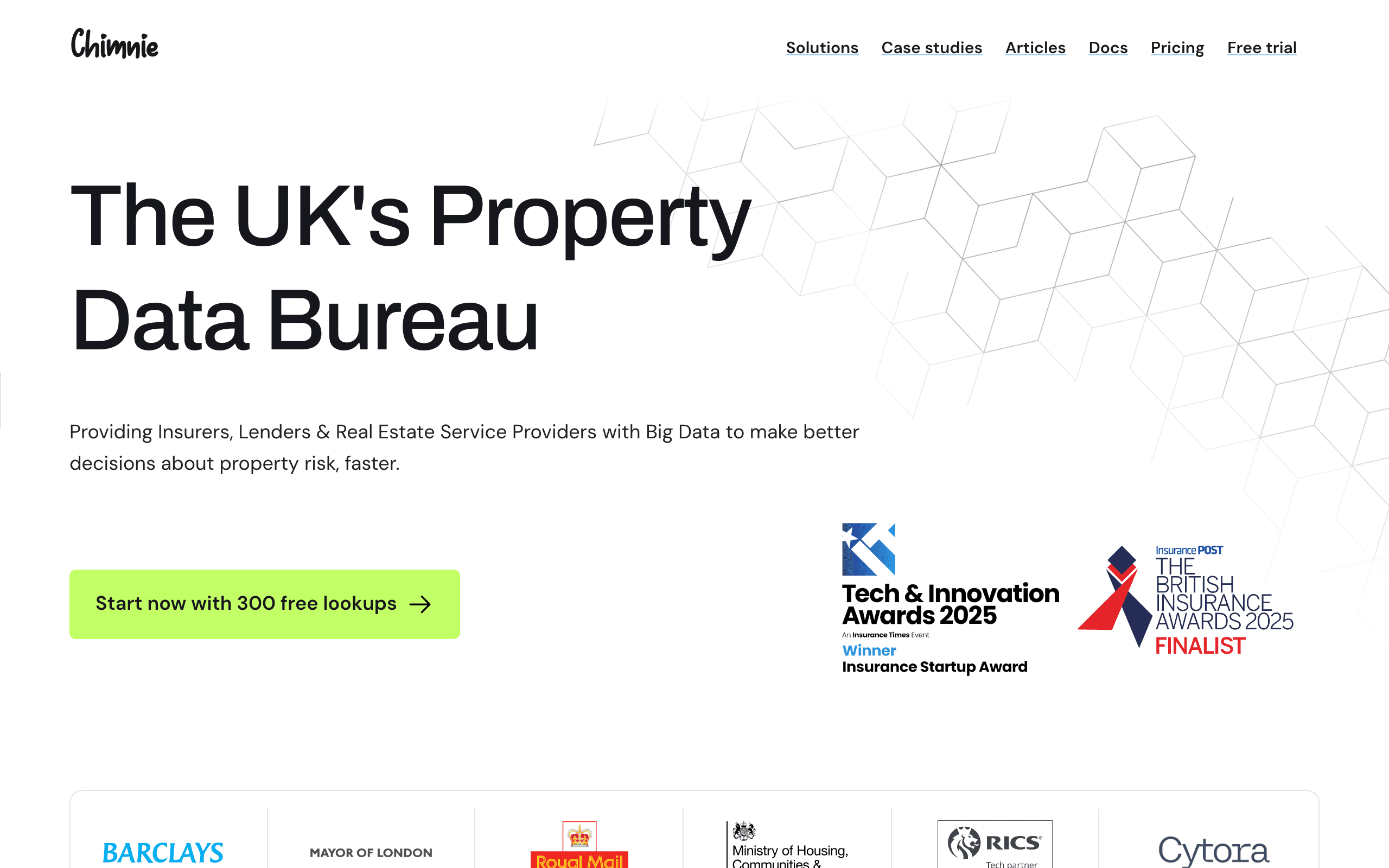
Chimnie property data API homepage
Where PriceHubble is stronger
PriceHubble is the better choice when multinational coverage, mortgage workflow automation, or embedded credit bureau distribution matter.
The WhenFresh data estate is genuinely deep. Two hundred datasets aggregated over more than a decade, with a Zoopla partnership that provides live listing data and household expenditure estimates that most competitors can't access. The cladding dataset is unique and increasingly relevant. The credit bureau reseller network means PriceHubble's data reaches lending and insurance decisions at a scale that direct API sales alone wouldn't achieve.
For mortgage lenders who want a turnkey decisioning layer - property screening, survey triage, portfolio monitoring, and securitisation enrichment in a single supplier - the LOOP/PATH/WATCH/WRAP suite is purpose-built. Chimnie can supply the underlying data, but it doesn't offer the workflow automation on top.
PriceHubble's 11-country coverage also matters for multinational banks and insurers with cross-border portfolios. Running a consistent valuation methodology across Switzerland, Germany, France, and the UK from a single vendor simplifies procurement and reduces integration complexity.
The AI Agents suite and Model Context Protocol are early-stage but directionally interesting. If agentic AI in property becomes a meaningful product category, PriceHubble is positioning itself to lead it.
Where Chimnie is stronger
Chimnie is the stronger choice when data transparency, per-property economics, and breadth of UK property intelligence matter.
For insurance use cases - underwriting, pricing, claims validation, fraud detection - Chimnie's data is purpose-built. Rebuild cost estimates with confidence intervals, risk scoring across dozens of perils, outbuilding mapping, and pre-fill APIs are designed around insurance workflows. PriceHubble's WhenFresh covers insurance prefill and risk scoring well, but doesn't offer rebuild cost modelling or the same level of physical property decomposition.
Pricing
transparency is a structural advantage. Published rates, a free tier, and open API documentation mean a technical team can evaluate Chimnie's data in days. PriceHubble's enterprise sales process - while standard for the sector - adds weeks or months to evaluation cycles.
The planning permission dataset, launching imminently after two years of national ingestion, will fill a gap that no other single UK provider covers. For anyone modelling property risk, tracking unauthorised development, or building valuation models that account for physical property changes, this data is hard to replicate.
Chimnie's coverage extends to 35 million+ properties including Scotland and Northern Ireland, against WhenFresh's 29.7 million, and the commercial property database opens a market segment that PriceHubble doesn't serve at all.
The consumer platform at chimnie.co.uk - with over 150,000 users checking and correcting data about their own properties - creates a feedback loop that continuously validates the B2B datasets. It's an unusual structural advantage. PriceHubble sells exclusively B2B and doesn't have a comparable ground-truth validation mechanism.
Who should choose which
Mortgage lenders needing end-to-end decisioning automation should look seriously at PriceHubble. The LOOP/PATH/WATCH/WRAP suite covers the full origination-to-securitisation lifecycle, and the ISAE 3000 audit gives regulatory comfort. Chimnie can supply enrichment data alongside this, particularly for risk signals, rebuild costs, and planning data that WhenFresh doesn't carry.
Insurers, MGAs, and reinsurers will find Chimnie's combination of rebuild cost modelling, risk scoring, published pricing, and API-first delivery more directly aligned with underwriting and pricing workflows. WhenFresh's insurance prefill and cladding data are strong complements if your risk model needs those specific inputs.
Multinational banks and insurers with cross-border property exposure should consider PriceHubble for the consistency of running valuations across multiple European markets from a single vendor. For UK-specific depth, Chimnie fills the gaps.
Property services firms and proptech teams building data-driven products will find Chimnie's self-service onboarding, published pricing, and developer-focused documentation more practical. PriceHubble's enterprise sales model is built for large institutional buyers, not for a startup that wants to test an API this afternoon.
Organisations that need commercial property data have a straightforward decision - Chimnie is currently the only option of the two that covers it.
Conclusion
PriceHubble and Chimnie aren't direct substitutes, despite operating in the same broad market. PriceHubble is a well-funded, acquisition-driven platform that has assembled significant UK capability through WhenFresh and Dataloft, with genuine strengths in mortgage decisioning, credit bureau distribution, and cladding data. Chimnie is a UK-native data bureau with strengths in pricing transparency, rebuild cost modelling, commercial property coverage, and the planning data that's about to go live nationally.
Many organisations will find value in using both - PriceHubble for mortgage workflow automation and the data that flows through credit bureau channels, Chimnie for enrichment, risk scoring, rebuild costs, commercial data, and the use cases where published pricing and self-service access matter.
Chimnie's pricing is published, the free AVM is live, and the API documentation is open - so working out whether it fits your needs takes minutes rather than months.