
Chimnie and LexisNexis Risk Solutions both serve the UK insurance market with property data, but they operate at different scales and with different product philosophies. LexisNexis is a large enterprise data and analytics provider with a broad portfolio spanning insurance, financial crime, and identity. Chimnie is a specialist property data bureau focused on delivering deep property intelligence via API at transparent, published pricing.
This comparison sets out where each provider is strongest for property-related use cases, what they actually deliver, and which type of buyer each one fits best.
Who is LexisNexis Risk Solutions?
LexisNexis Risk Solutions is a division of RELX, the Anglo-Dutch information analytics group. The risk solutions business reported revenue of over $3 billion in 2024, serving insurance, financial services, government, and healthcare clients globally. The UK insurance operation is headquartered in London and has been a data supplier to the UK property and casualty market for over two decades.
For property insurance specifically, LexisNexis offers several products. Map View is a geospatial platform that lets insurers visualise perils exposure, accumulations, and individual property risk on a map interface. It includes proprietary crime and arson scores alongside third-party flood, subsidence, and weather data. The platform supports both point-of-quote enrichment and portfolio-level accumulations management.
LexisNexis also runs a contributory claims database, where participating insurers share claims data and in return get access to claims history on individual properties and policyholders. This contributory model is a significant differentiator - the data gets better as more insurers participate, and the claims signals it produces are difficult to replicate from public sources alone.
The company acquired Insurance Initiatives Ltd (IIL) in 2016, a UK data distribution platform that processes and delivers data into the point-of-quote workflow for property and casualty insurers. This acquisition strengthened its position as the plumbing layer between data suppliers and insurer pricing engines.
Pricing is enterprise-negotiated and not published. Contracts typically involve annual commitments with volume-based pricing, and the sales cycle is measured in months rather than days.

LexisNexis Risk website homepage screenshot
Who is Chimnie?
Chimnie was founded by Jon Francis, formerly of Google's innovation team, with a focus on making UK property data more transparent and accessible. The company operates chimnie.com as a B2B property data bureau for insurers, lenders, and proptech firms, alongside chimnie.co.uk, a free consumer property research site with over 150,000 users.
Chimnie's REST API covers 35 million UK residential properties and returns over 500 attributes per property. These span EPC data, flood risk, subsidence, conservation areas, listed buildings, rebuild cost estimates, automated valuations, and structural characteristics. The company is completing a two-year ingestion of planning permission data from every UK local authority, launching imminently as the only full national planning dataset from a single provider.
Pricing is published: residential lookups from £0.05 to £0.15 per property PAYG, commercial lookups at £0.45, with volume discounts via a ratecard.
Feature comparison
Perils and risk data
LexisNexis has built its insurance business around perils data delivery. Map View aggregates flood, subsidence, storm, crime, and arson risk scores at the property level, with the ability to visualise accumulations across a portfolio. The platform is designed for underwriters who need to see risk geographically and manage exposure across their book.
Chimnie covers flood, subsidence, crime, pollution, traffic, tree-fall risk, roof condition (detected via satellite imagery), solar panel presence, garden boundaries, and listed building status. The data is returned per property via API, structured for integration into pricing engines and automated workflows rather than a visual mapping tool.
Both providers cover the core perils. LexisNexis adds proprietary crime and arson scores and the visual accumulations management layer. Chimnie adds planning data, rebuild costs, satellite-derived property characteristics, and a deeper set of structural attributes per property.
Claims data
LexisNexis operates a contributory claims exchange. Insurers who share their claims data get access to the pooled dataset, which includes claims history at the property and policyholder level. This is a unique asset - the claims signals are not available from public sources, and the contributory model means the data improves with scale.
Chimnie does not hold claims data. Its focus is on property characteristics and environmental risk rather than insurance transaction history. If claims-level intelligence is a requirement, LexisNexis has data that Chimnie (and most other property data providers) cannot match.
Automated valuations
Chimnie provides the UK's only free AVM, offering UPRN-based lookups at zero cost with separate listing and sale price models. LexisNexis does not offer a property valuation product. Its focus is on risk and claims data rather than property value estimation.
Planning permission data
Chimnie has been completing a two-year national ingestion of planning permission records from every UK local authority, standardised into a consistent schema. This captures extensions, conversions, and changes of use that affect property risk profiles but don't show up in EPC or transaction records. LexisNexis does not offer a planning data product.
Rebuild cost estimates
Chimnie provides rebuild cost estimates with confidence intervals, finish-quality segmentation, and regional materials and labour breakdowns. LexisNexis does not offer its own rebuild cost model, though some insurers may source rebuild data through other providers and integrate it alongside LexisNexis perils scores.
Commercial property
Chimnie operates a dedicated UK Commercial Property Database. LexisNexis serves commercial property insurers through Map View and its commercial insurance products, providing perils and accumulations data for commercial portfolios.
Pricing and access
The pricing models are fundamentally different. Chimnie publishes its rates online: £0.05 to £0.15 per residential property lookup, £0.45 for commercial. You can sign up for a free trial, access the API documentation, and be making API calls the same day.
LexisNexis pricing requires a commercial discussion, typically involving annual contracts, minimum commitments, and volume-based tiers. The sales cycle for a new customer is measured in months, and pricing is opaque from the outside. For large insurers already embedded in the LexisNexis ecosystem, this is standard. For smaller MGAs, insurtechs, or proptech firms evaluating options, the procurement barrier is high.
Where LexisNexis is stronger
The contributory claims database is LexisNexis's most distinctive asset. No other UK provider offers pooled claims data at this scale, and the signals it produces - repeat claimants, properties with unusual claims frequency, fraud indicators - are genuinely valuable for underwriting and pricing.
Map View's visual accumulations management is another strength. Underwriters managing a book of business across geographic regions need to see where their exposure is concentrated, especially after weather events. The ability to overlay live portfolio data with perils maps and run exposure scenarios is a workflow that Chimnie's API-first approach doesn't directly replicate.
LexisNexis also benefits from its established position in the insurance market. Most UK insurers already have some form of LexisNexis integration, which makes adding new data products from the same supplier relatively straightforward. The compliance infrastructure, service level agreements, and enterprise support that come with RELX's scale are expected by large insurance groups.
Where Chimnie is stronger
Chimnie's data is deeper per property. Over 500 attributes - including structural characteristics, satellite-derived features, detailed environmental scoring, and planning history - provide more granular input for pricing models than the perils-focused data LexisNexis typically delivers at point of quote.
The free AVM, rebuild cost model, and planning permission dataset are products that LexisNexis doesn't offer. For insurers trying to price buildings insurance accurately, the combination of rebuild costs with confidence intervals, planning-derived property modifications, and automated valuations fills gaps that perils data alone leaves open.
Price and accessibility matter. Chimnie's published pricing and self-service API access mean an MGA or insurtech can integrate property data into its pricing engine for a fraction of what an enterprise LexisNexis contract costs. For firms building from scratch or optimising unit economics on high-volume portfolios, the cost difference is material.
The consumer platform at chimnie.co.uk - with over 150,000 users checking their own property data - creates ground-truth validation that enterprise data platforms don't get. Homeowners flagging inaccuracies in their own records is a feedback loop that improves data quality in ways that top-down data aggregation misses.
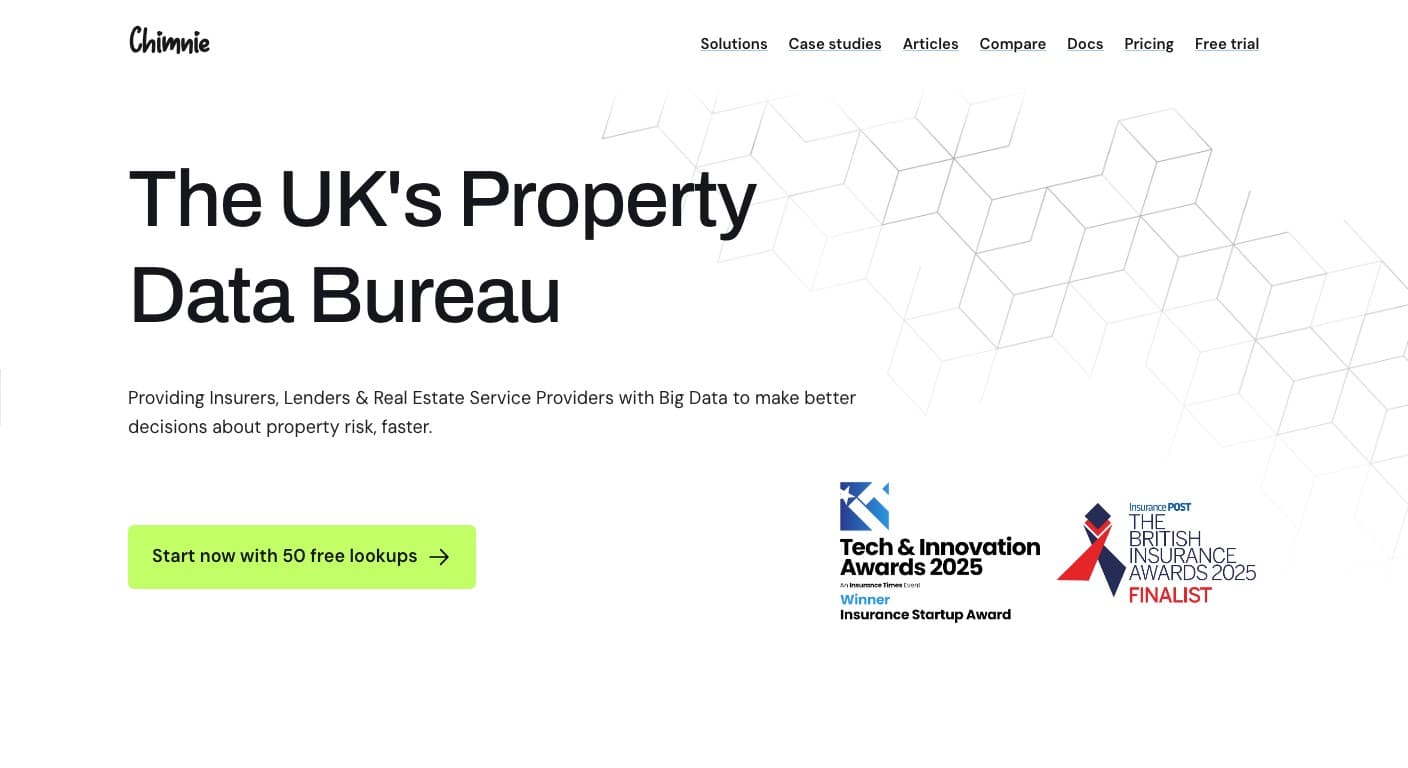
Chimnie website homepage screenshot
Who should choose which
Large insurers and reinsurers who need claims history data, visual accumulations management, and enterprise-grade support should use LexisNexis. The contributory claims database in particular is irreplaceable, and Map View's portfolio visualisation tools serve a workflow that no API-only provider replicates directly.
MGAs, insurtechs, and smaller insurers building modern pricing engines should look at Chimnie. The data is deeper per property, the pricing is transparent and affordable at volume, and the API-first delivery fits automated underwriting pipelines. If you don't need claims history data, Chimnie covers the property intelligence side more thoroughly and more cheaply.
For many insurers, the answer is both. LexisNexis for claims signals and portfolio accumulations management; Chimnie for deep property attributes, rebuild costs, valuations, and planning data. The two datasets are complementary rather than substitutes for serious underwriting operations.
Conclusion
LexisNexis Risk Solutions and Chimnie serve overlapping but distinct parts of the UK property insurance data market. LexisNexis brings enterprise scale, contributory claims data, and visual portfolio management tools. Chimnie brings deeper property-level intelligence, transparent pricing, planning data, rebuild costs, and a modern API designed for automated workflows.
The choice depends on what kind of data you need most and how you plan to consume it. For claims history and accumulations management, LexisNexis is the established provider. For property-level depth, speed of integration, and cost efficiency, Chimnie has the edge. Most serious insurance data operations will benefit from both.