
Recent developments
In March 2026, Landmark Information Group expanded its Project 28 Charter initiative, opening membership to a wider range of organisations across the property transaction chain. The charter aims to reduce the time between offer and exchange to 28 days through a coordinated digital-first approach. Landmark is positioning itself as a convener for the sector, bringing together lenders, conveyancers, and agents around a shared data and process standard.
Landmark and Chimnie both operate in UK property data, but they come at it from very different eras and very different business models. Landmark is a 30-year-old institution backed by DMGT, dominant in conveyancing environmental searches and embedded in the legal workflow of almost every property transaction in England and Wales. Chimnie is a modern property data bureau built for insurers, lenders, and technology teams who need structured data via API at transparent pricing.
This comparison is based on publicly available product information, pricing, and direct experience working with both platforms. It's written to help data and procurement teams understand where each one fits.
Recent developments
17 March 2026: Landmark Information Group's Project 28 Charter won Corporate & Brand Campaign of the Year at the PRCA Public Affairs Awards. The cross-industry initiative, which aims to cut the average time from sale agreed to exchange from 112 days to 28, is now transitioning from a voluntary charter into a formal membership body. This broadens its reach across estate agents, conveyancers, lenders, and brokers.
12 February 2026: Landmark Estate Agency Services announced a partnership with Greenhouse OS, integrating its anti-money laundering (AML) API directly into the Greenhouse CRM platform. Estate agents can now order and manage identity verification, sanctions screening, and politically exposed persons (PEP) checks without leaving their CRM. Landmark said the move is part of its LandmarkConnect API integration programme, aiming to reduce administrative workload and support agents in meeting HMRC requirements.
5 March 2026: Landmark facilitated the first live residential property transfer (TR1) completed using Qualified Electronic Signatures (QES), representing a significant milestone in the digitisation of the conveyancing process in England and Wales. The development follows years of industry collaboration to meet HM Land Registry requirements for electronic signatures on legal transfers. Landmark has been a central participant in the working group that developed the technical and legal framework for QES adoption, and the live transaction signals that digital signing for conveyancing is moving from pilot into operational use.
Who is Landmark?
Landmark Information Group was incorporated in 1994 and is wholly owned by DMGT (Daily Mail and General Trust), the private media group controlled by Lord Rothermere. DMGT's Property Information division - which includes Landmark alongside Trepp US and Yopa - reported revenue of £219 million in FY2024, up four per cent year-on-year.
Landmark's core business is environmental and property risk reports for conveyancing. Its Envirosearch and RiskView products are staples of the residential transaction process, and the group claims involvement in over 97 per cent of property transactions in England and Wales. That's not marketing fluff - Landmark's reports are effectively a regulatory standard. Over 350 local authorities use their historical land use data for Part 2A contaminated land strategies, and each report carries professional indemnity cover of £10 million.
The group structure is sprawling. SearchFlow handles one-stop conveyancing searches. OneSearch Direct runs the largest local search database in the UK. Millar and Bryce covers Scotland. Ochresoft builds conveyancing workflow software. Optimus manages lender panels. The Valuation Services arm runs SPN+, processing 1.5 million-plus valuation instructions a year for every major high-street lender. Depending on which source you believe, the headcount sits somewhere between 540 and 1,000.
What makes Landmark genuinely hard to replicate is its data partnerships. It's one of Ordnance Survey's largest partners, was the first Value Added Reseller for the British Geological Survey, and - critically - is the sole commercial partner of the Environment Agency for surface water flood data with depths. Nobody else can sell that dataset commercially. Full stop.
The company draws on 700-plus datasets from nearly 400 suppliers, totalling over one billion unique data features. Its Argyll Environmental consultancy provides in-house expert review on every report, so a conveyancer ordering an Envirosearch isn't just getting data - they're getting a consultant-backed opinion.
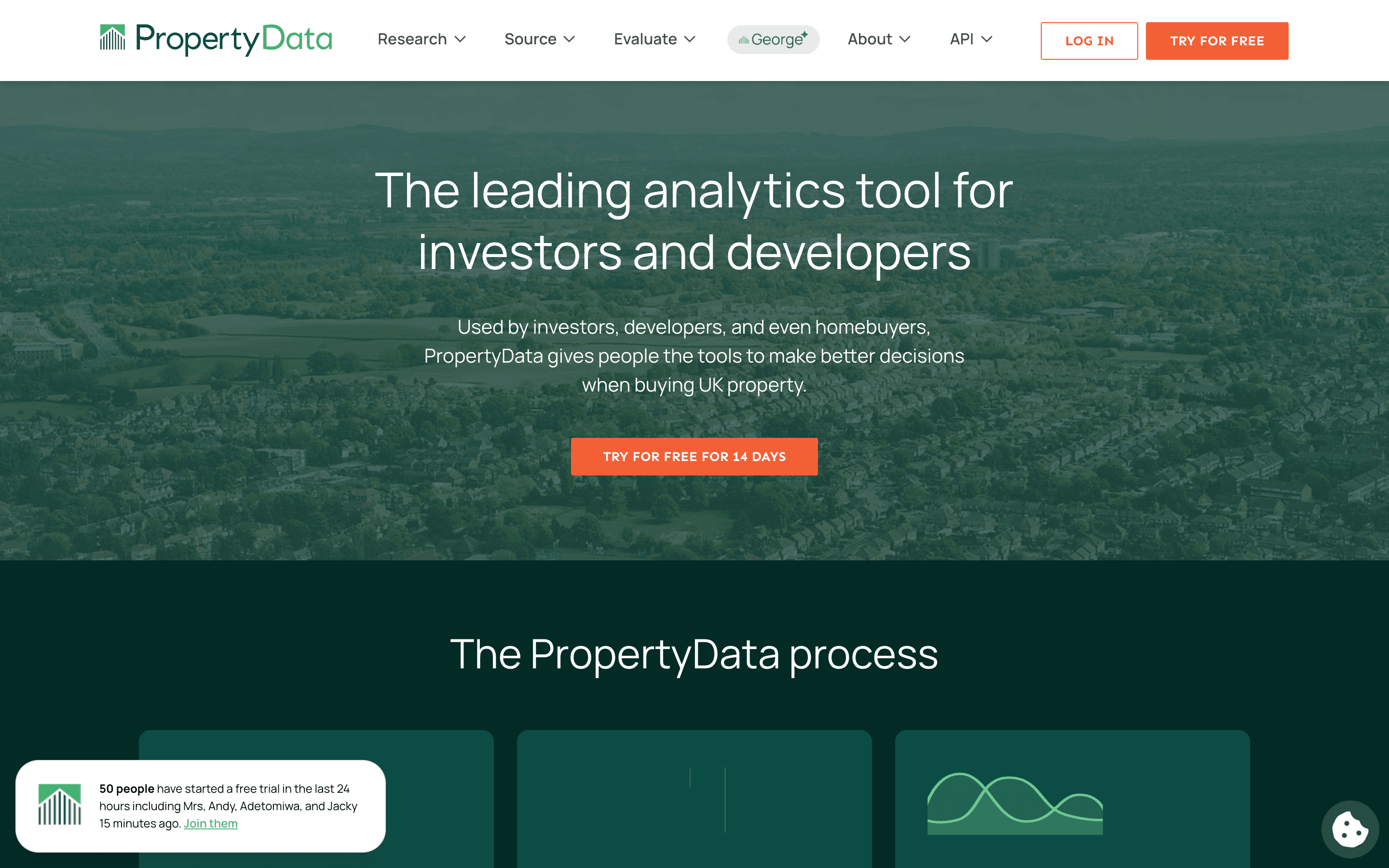
PropertyData property market analytics website screenshot
Who is Chimnie?
Chimnie was founded by Jon Francis, a former data scientist from Google's innovation team, with the goal of making UK property data more transparent and accessible. The company operates two platforms: chimnie.com, a B2B property data bureau serving insurers, lenders, and property services firms; and chimnie.co.uk, a free consumer research site with over 150,000 users whose feedback validates the underlying data at scale.
Chimnie processes around 30 million virtual property assessments each month, drawing on hundreds of geospatial, environmental, and proprietary datasets. Its product range includes the UK Residential Property Database, the UK Commercial Property Database, a free AVM, rebuild cost estimates, address autocomplete, risk scoring, and AI training data. Delivery is via API or flat file, with pay-as-you-go pricing from £0.45 per property and ratecard volume discounts.
Feature comparison
Environmental risk
data
This is Landmark's home ground. Envirosearch Residential (£85.95 plus VAT) covers contaminated land, flood risk, ground stability, radon, coal mining, and climate change factors in a single report. RiskView Residential (£131.25 plus VAT) adds planning impact analysis and expert consultant commentary. These reports are designed for the specific requirements of conveyancing due diligence and meet Law Society and SRA standards.
Chimnie covers flood, subsidence, pollution, ground stability, and other environmental perils as individual data points returned via API. The scope overlaps for many use cases, but Chimnie doesn't package its data as a consultant-backed report with PI cover. In conveyancing, that packaging matters. In insurance underwriting or portfolio screening, it doesn't - you want the raw data, not the PDF.
Flood data
Landmark holds an exclusive commercial licence for Environment Agency surface water flood data with depths. This is a genuine differentiator that no other commercial provider can match. Landmark's dedicated flood report (£42.50 plus VAT) and its FloodSolutions Consult product (£250 plus VAT for a fully manual site-specific assessment) are industry benchmarks.
Chimnie provides flood risk data from multiple sources covering pluvial, fluvial, and coastal modelling. For most insurance and lending use cases, that's enough. But if you specifically need Environment Agency surface water depth data, Landmark is the only commercial route.
Automated valuation model (AVM)
Landmark doesn't offer an AVM. It manages surveyor panel instructions through SPN+, but there's no automated valuation product you can call programmatically.
Chimnie's free AVM uses Bayesian hierarchical methods with calibrated confidence intervals, runs separate listing and sale price models at micro-postcode granularity, and is built for volume. If you're a mortgage broker or insurer wanting a valuation on every case rather than just the tricky ones, Landmark can't help you here.
Planning data
Landmark offers a dedicated planning report (£42.50 plus VAT) that assesses the impact of nearby planning applications on a property, powered by Barbour ABI's planning and construction intelligence data. It's a useful product within the conveyancing workflow but is delivered as a per-property report rather than a queryable dataset.
Chimnie is completing two years of national planning data ingestion - standardising permissions from every local authority in England and Wales into one consistent schema. The dataset launches imminently and will be the only full UK planning permission dataset available from a single provider via API. That's a step change for anyone doing risk modelling, development analysis, or property enrichment at scale.
Rebuild cost estimates
Chimnie provides rebuild cost estimates with confidence intervals, finish-quality segmentation, and decomposed materials and labour breakdowns at regional level. This is a core product for insurance underwriting and claims validation. Landmark doesn't offer a standalone rebuild cost product.
Property attributes
and physical features
Chimnie returns 500-plus property attributes per API call - structural characteristics, outbuilding mapping, extensions, roof type, solar panel detection via satellite imagery, garden boundaries, and more. Landmark goes deep on environmental risk but doesn't stretch to this kind of physical property detail. Need to know a property has a detached garage, a rear extension, and solar panels on a south-facing roof? That's Chimnie's territory.
Delivery and integration
Landmark delivers PDF reports through its portal or through 100-plus search provider partners. The model works for conveyancers ordering reports on individual properties, but there's no self-service API, no per-property data endpoint, and no path into automated pipelines without an enterprise sales process.
Chimnie is API-first. REST endpoints return structured JSON, bulk queries are supported, and the documentation is open without a sales call or NDA. Different worlds.
Pricing and access
Landmark charges per report. Homecheck (basic environmental screen) runs £59.75 plus VAT. Envirosearch is £85.95. RiskView hits £131.25. Individual flood or planning searches are £42.50 each. Fine for one-off conveyancing transactions. Prohibitive at volume.
Chimnie starts at £0.45 per property on a pay-as-you-go basis, with ratecard discounts as volume grows. That's roughly 130 to 290 times cheaper per property than Landmark's entry-level reports - which is what makes it practical to screen entire portfolios or enrich every insurance quote.
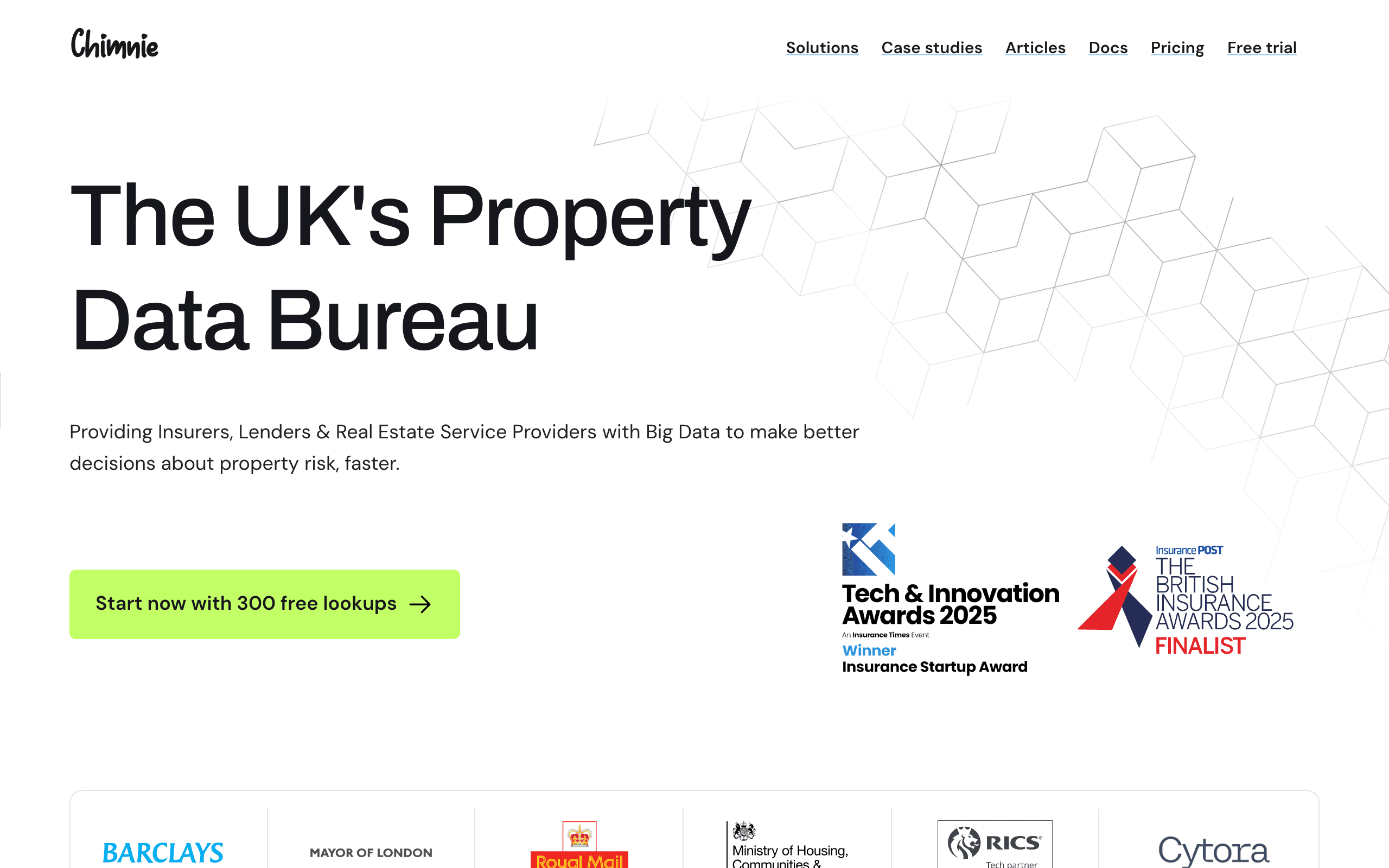
Chimnie property data API homepage
Commercial property data
data
Chimnie offers a dedicated UK Commercial Property Database covering offices, retail, warehouses, and mixed-use properties. Landmark provides commercial conveyancing reports (Sitecheck range, from £225 plus VAT), but these are transaction-focused environmental assessments rather than a structured commercial property data product.
Where Landmark is stronger
If you need conveyancing environmental due diligence, Landmark is the answer. Its reports meet Law Society and SRA requirements, carry £10 million PI cover, and include consultant commentary from Argyll Environmental. For property lawyers, this isn't optional - it's what the process demands.
The exclusive Environment Agency surface water flood partnership is a genuine moat. If you need that dataset, there's nowhere else to go commercially.
SPN+ processes 1.5 million-plus valuation instructions a year and serves every major high-street lender. That's mature infrastructure running since 1982. Landmark's distribution network reinforces this dominance - 100-plus search provider partners resell its reports, so conveyancers get Landmark data through whichever supplier they already use. It doesn't need to win the end customer directly.
Worth noting too: Landmark's Project 28 Charter, signed by HSBC, Lloyds, Nationwide, Legal and General, and others, positions it as the firm that shapes how the property transaction process evolves. That kind of industry convening power is hard to buy.
Where Chimnie is stronger
Chimnie wins when you need property data at scale, at speed, and at a price that makes high-volume use viable.
Insurance is the clearest example. Rebuild cost estimates with confidence intervals, risk scoring across dozens of perils, outbuilding mapping, and pre-fill APIs are designed for underwriting, pricing, and claims workflows. You can't feed PDF reports into an automated underwriting pipeline. You can feed Chimnie's API responses.
For mortgage brokers and sourcing platforms, the free AVM means a valuation on every case, not just the ones that look odd. The planning data - launching imminently after two years of national ingestion - will capture extensions, conversions, and outbuildings that haven't triggered a new transaction or EPC. Landmark doesn't offer an AVM at all.
Time-to-value is the other factor. A technology team can go from reading Chimnie's documentation to live API calls in hours. Landmark's enterprise sales model means weeks or months of procurement. For startups and data science teams, that gap matters as much as the price difference.
Chimnie.co.uk - with 150,000-plus users - also creates a ground-truth feedback loop. Homeowners check their own property details and flag inaccuracies, which feeds back into the B2B data. That's a quality mechanism Landmark's 700-plus datasets can't replicate through aggregation alone.
And the economics: £0.45 per property versus £59.75 to £131.25 per report. Chimnie makes it feasible to enrich every property in a portfolio. Landmark assumes you're enriching one at a time.
Who should choose which
Property lawyers and conveyancers still need Landmark. Its environmental reports are the standard for due diligence, and conveyancing regulations make them non-optional. Chimnie can't substitute here.
Insurers, MGAs, and reinsurers should look at Chimnie first. Risk data, rebuild cost modelling, the AVM, and API delivery all map directly to underwriting and pricing workflows. Landmark's per-report model and PDF delivery aren't built for this.
Mortgage lenders likely need both. SPN+ is woven into the valuation instruction workflow, and Landmark's environmental reports are part of the transaction chain. But Chimnie's AVM and property enrichment can supplement pre-screening at volumes where Landmark's pricing becomes impractical.
Estate agents should evaluate Landmark's LandmarkAgent platform for AML compliance and material information under the DMCC Act 2024 - it's purpose-built for those obligations. Chimnie supports property enrichment in agency contexts but hasn't built specific agent compliance tooling.
Proptech firms and data science teams will find Chimnie's APIs, transparent pricing, and training data far more practical. Landmark's enterprise model isn't set up for self-service integration.
Conclusion
Landmark and Chimnie serve the UK property data market from opposite ends. Landmark is a 30-year-old institution that owns the conveyancing environmental search workflow - and for good reason. Its data partnerships, consultant-backed reports, and regulatory standing are genuinely hard to replicate. If you're buying or selling a house in England and Wales, Landmark's data is almost certainly part of the process whether you know it or not.
Chimnie is a modern property data bureau built for the use cases that Landmark's per-report model doesn't serve well - high-volume enrichment, insurance underwriting, automated valuations, and real-time API integration. At a fraction of the cost per property, it opens up property data to workflows and price points that Landmark's architecture wasn't designed for.
For many organisations, the choice isn't one or the other. Landmark for the conveyancing chain where its reports are required; Chimnie for everything else where you need structured data at scale. Chimnie's pricing is published, the free AVM is live, and the API documentation is open - so evaluating whether it fits your needs takes minutes rather than months.