
Chimnie and Hometrack both provide property data to UK lenders and financial services firms, but they occupy very different positions in the market. Hometrack is an established incumbent - part of the Zoopla group - with a dominant position in mortgage AVM decisioning. Chimnie is a newer entrant offering broader property data at substantially lower price points via a modern API.
This comparison is based on publicly available product information, published pricing where available, and direct experience with both platforms. The goal is to help data and procurement teams work out which fits their specific requirements.
Recent developments
March 2026: Reports have continued to circulate that Silver Lake, which acquired ZPG (Hometrack's parent group) for £2.2 billion in 2018, is exploring a sale or break-up of its ZPG assets. JP Morgan and Arma Partners are understood to have been engaged to advise on a strategic review, with a series of individual asset sales considered the most likely outcome. The potential sale would directly affect Hometrack, Zoopla, and OnTheMarket within the group. No deal has been announced.
24 February 2026: Zoopla, part of the Houseful group alongside Hometrack, acquired newhomesforsale.co.uk, a new-build property portal with over 200 developer customers covering 2,500 active developments. The acquisition follows distribution partnerships with Taylor Wimpey and Persimmon Homes and the rollout of AI tools designed to identify high-intent buyers and streamline reservation pipelines for housebuilders.
Who is Hometrack?
Hometrack has been operating since 1999 and was acquired by Zoopla in 2017. It sits within the Zoopla group alongside On The Market and other property brands, giving it access to a large volume of listing data and transaction records.
The company's core product is its automated valuation model (AVM), which it describes as the UK market leader. Hometrack claims that 17 of the top 20 UK mortgage lenders use its AVM as part of their origination processes. The AVM is delivered through the Property Risk Hub - a cloud-based decisioning platform that integrates with lenders' mortgage systems and applies business rules to determine whether an automated valuation, a desktop review, or a physical survey is needed.
Beyond the AVM, Hometrack offers EPC data (through a partnership with CLS), HM Land Registry title and tenure data, and market intelligence products. The Property Risk Hub is designed to sit at the centre of a lender's property assessment workflow, routing cases based on risk thresholds.
Hometrack's pricing is enterprise-oriented and not published online. Its consumer Property Valuation Report costs £19.95 including VAT, which gives a rough indication of AVM value at consumer level. For B2B AVM lookups, pricing is understood to be in the range of £20 to £25 per lookup, though volume agreements will bring this down. The enterprise sales process typically involves a multi-month procurement cycle.
Hometrack has also been investing in climate risk data through its partnership with Twinn, positioning itself for the regulatory push around environmental risk in mortgage lending.
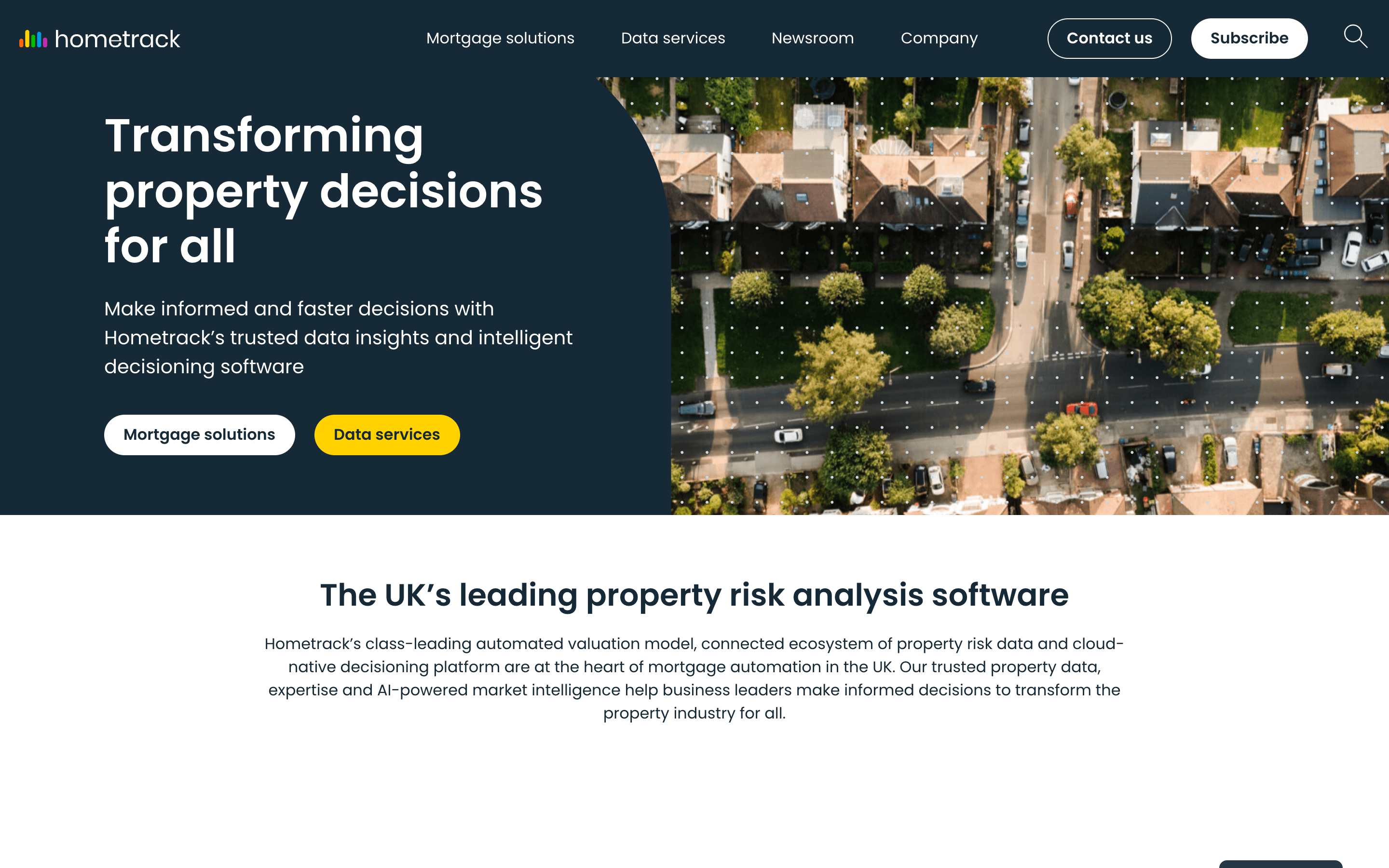
Hometrack property data platform website screenshot
Who is Chimnie?
Chimnie was founded by Jon Francis, a former data scientist from Google's innovation team, with the goal of making UK property data more transparent and accessible. The platform covers 35 million-plus UK residential properties and returns over 500 attributes per property through a documented REST API.
Chimnie processes around 30 million virtual property assessments each month, drawing on hundreds of geospatial, environmental, and proprietary datasets. Its commercial API starts at £0.45 per property on a pay-as-you-go basis, with ratecard volume discounts available. Residential lookups are priced from £0.05 to £0.15 per property.
The consumer platform at chimnie.co.uk serves over 150,000 users researching their own properties, creating a feedback loop that improves data accuracy.
Feature comparison
Automated valuation model (AVM)
Both platforms offer AVMs, but they're built for different economics. Hometrack's AVM is deeply embedded in the UK mortgage origination workflow, used by 17 of the top 20 lenders. It includes a combined AVM and confidence-validated valuation (CVV) model that Hometrack says drives a 7% increase in AVM pass rates.
Chimnie's AVM uses Bayesian hierarchical methods, runs separate listing and sale price models, and provides calibrated confidence intervals at UPRN level. The key commercial difference is price: Chimnie's AVM lookups are included at zero additional cost. Hometrack's B2B AVM pricing - understood to be around £20 to £25 per lookup before volume discounts - means the cost difference is significant for high-volume users.
For a mortgage lender processing 50,000 applications a year and running an AVM on each, the difference between £0 and £20 per lookup is £1 million annually. That gap is hard to ignore even if Hometrack's model has more established lender acceptance.
Property risk data
Chimnie returns over 500 property attributes per API call covering flood, subsidence, pollution, crime, energy performance, roof condition (satellite-detected), outbuilding mapping, extensions, listed building status, conservation areas, tree-fall risk, and solar potential. This breadth of risk data in a single call is unusual in the market.
Hometrack's Property Risk Hub provides property risk data as part of its decisioning workflow, with EPC data via CLS and Land Registry data. However, the risk data available through Hometrack is narrower in scope - it's designed to support mortgage lending decisions rather than comprehensive property risk profiling.
Rebuild cost estimates
Chimnie provides rebuild cost estimates with confidence intervals, finish-quality segmentation, and decomposed materials and labour breakdowns at regional level. This is directly relevant to insurance underwriting.
Hometrack doesn't offer rebuild cost data. Its focus is on market value (what a property would sell for) rather than replacement cost (what it would cost to rebuild).
Planning data
Chimnie is completing two years of national planning permission ingestion from every UK local authority, standardised into a consistent schema. This dataset flags whether a specific address has active or historical planning permissions, which affects both valuation and risk assessment.
Hometrack doesn't provide planning data as a standalone product.
EPC data
Both platforms offer EPC data. Hometrack provides it through its CLS partnership, positioning it as "live EPC data" with certificates available as soon as they're published. Chimnie includes EPC data as part of its standard property attributes.
Market intelligence
Hometrack benefits from its position within the Zoopla group, giving it access to listing data and market trends. Its monthly UK House Price Index and market reports are widely cited. This market-level intelligence is valuable for strategic decisions.
Chimnie's focus is property-level rather than market-level. It doesn't produce market indices or trend reports.
Pricing and access
Hometrack's pricing is enterprise-negotiated and not transparent. AVM lookups are understood to cost around £20 to £25 each at standard rates. Access requires a sales conversation and typically a significant annual commitment.
Chimnie publishes its full pricing. Commercial lookups are £0.45 per property PAYG, with volume discounts via ratecard. The AVM is included at no extra cost. Residential tiers run from £0.05 to £0.15 per property. API documentation is open without needing a sales call.
The pricing gap between the two platforms is substantial. A lender spending £500,000 a year on Hometrack AVM lookups could access Chimnie's entire property dataset - AVM included - for a fraction of that cost.
Where Hometrack is stronger
Hometrack's position in the mortgage market is deeply entrenched. When 17 of the top 20 lenders already use your AVM, switching costs are real - not just financially, but in terms of regulatory validation, model governance, and integration with existing systems.
The Property Risk Hub's decisioning capabilities go beyond raw data. Lenders can apply their own business rules, route cases automatically, and integrate third-party data sources. This workflow orchestration is something Chimnie doesn't offer.
Hometrack's market data heritage, backed by Zoopla listing volumes, gives it credibility in market-level intelligence that newer entrants haven't matched. The monthly House Price Index is treated as authoritative by analysts and media.
The Twinn climate risk partnership positions Hometrack well for the emerging regulatory requirements around environmental risk in mortgage portfolios. Leeds Building Society's case study suggests this is already a differentiator.
And the simple fact of being an established player matters in financial services procurement. Many lenders have compliance and model risk frameworks that favour known, validated providers.
Where Chimnie is stronger
The pricing difference is the most obvious advantage. Chimnie's AVM at zero cost per lookup versus Hometrack's £20-plus means the economics of running valuations on every case - not just sampled cases - become practical.
Data breadth is the second factor. Chimnie returns 500-plus property attributes in a single API call, covering risk signals that Hometrack's platform doesn't address - subsidence, pollution, roof condition, tree-fall risk, outbuilding mapping, rebuild costs. For organisations that need property enrichment beyond valuation, Chimnie provides more data per call.
Rebuild cost estimates fill an insurance need that Hometrack doesn't serve at all. If your use case spans both lending and insurance, Chimnie covers both.
The planning permission dataset - standardised across every UK local authority - is something no other single provider has completed. For compliance, conveyancing, and property risk assessment, this data matters.
Time-to-value is a practical advantage. Chimnie's published pricing, open API docs, and free tier mean a development team can evaluate and integrate in days. Hometrack's enterprise procurement process takes months.
The consumer platform at chimnie.co.uk, with 150,000-plus users, generates a ground-truth feedback loop. Homeowners checking and correcting their own property data creates accuracy improvements that pure B2B platforms don't benefit from.

Chimnie website homepage screenshot
Who should choose which
Large mortgage lenders already using Hometrack are unlikely to switch in the short term. The AVM is embedded in their origination workflow, regulatory validation is in place, and the cost of switching - in time and risk - often exceeds the annual savings.
Smaller lenders, challenger banks, and specialist mortgage providers should look at Chimnie. The per-lookup pricing makes it practical to run valuations on every case without a large upfront commitment. Integration is faster, and the broader data set supports more than just valuation.
Insurers, MGAs, and reinsurers should choose Chimnie. Hometrack doesn't serve the insurance use case - no rebuild costs, no subsidence data, no property-level risk profiling. Chimnie is built for this.
Mortgage brokers and sourcing platforms will find Chimnie's free AVM commercially attractive. At zero cost per lookup, there's no reason not to run a valuation on every case.
Proptech firms building property-related products need programmatic access to structured data at scale. Chimnie's API-first approach, transparent pricing, and documented endpoints are more practical than Hometrack's enterprise model.
Conclusion
Hometrack is the incumbent in UK mortgage AVM decisioning, with market penetration that speaks for itself. If your primary need is an AVM with established lender acceptance and you're a large mortgage lender, Hometrack's position is hard to argue with.
But the market is shifting. The economics of £20-plus per AVM lookup look increasingly difficult to defend when alternatives exist at a fraction of the cost. For any buyer looking at property data more broadly - risk enrichment, rebuild costs, planning data, insurance underwriting - Chimnie covers significantly more ground at significantly lower cost.
Chimnie's pricing is published, the API documentation is open, and the free tier lets you evaluate without a sales call. For many organisations, that's enough to at least run a parallel test alongside whatever they're using today.