
If you're sourcing UK property data for insurance, lending, or valuation workflows, Cotality - the company formerly known as CoreLogic - will almost certainly appear on your shortlist. It's the dominant player in UK property surveying software and AVM services. Chimnie will be there too, offering a different proposition built around attribute depth, transparent pricing, and speed of integration. This comparison sets out where each provider is genuinely stronger and who each one suits best, drawing on publicly available product documentation and market data.
Recent developments
31 March 2026: Cotality launched its Model Context Protocol (MCP) Server and AI-Ready Data assets, positioning the platform as a structured data connector between AI systems — including ChatGPT, Claude, and Gemini — and its property and location intelligence. The MCP Server is designed to let AI agents query Cotality data in real time without bespoke API integration, targeting underwriting, valuation, and risk workflows. The launch follows a broader industry move towards agentic AI tooling and signals Cotality's intent to become infrastructure for AI-driven property workflows rather than a point product.
26 February 2026: Cotality appointed Wayne Peacock, former chief executive of USAA, as an independent member of its board of directors. Peacock spent over a decade at USAA, leading the financial services group from 2019 to 2024. The appointment broadens Cotality's board profile in financial services and insurance, the two sectors it serves most directly.
Who is Cotality (formerly CoreLogic)?
CoreLogic rebranded to Cotality in March 2025, adopting the tagline "Intelligence beyond bounds." The name change wasn't cosmetic - it followed the 2021 acquisition by private equity firms Stone Point Capital and Insight Partners, and is widely seen as positioning for a future exit or IPO.
The numbers tell the story of a business with serious scale. Cotality employs roughly 5,200 people globally, reported approximately $1.6 billion in revenue (the last publicly disclosed figure), and operates across the US, Canada, UK, Australia, New Zealand, India, Germany, and Brazil. The UK division isn't an afterthought - it's a substantial operation with dedicated products across lending, surveying, insurance, and retrofit assessment.
In the UK specifically, Cotality monitors 30.9 million residential properties daily, holds 150 million property transactions in its database, and draws on over 100 data sources to compile 135 data points per property. Its flagship AVM, IntelliVal, is AI-powered and claims 100% UK property coverage with 77% accuracy within 10% of actual sale values. That AVM is used by over 80% of UK buy-to-let lenders - a statistic that speaks to deep institutional entrenchment rather than mere brand recognition.
Cotality's dominance extends beyond valuations. Its software handles 86% of UK surveyor panel management and processes over 95% of property surveying instructions nationally. If you've had a mortgage valuation done in the UK in the last decade, there's a good chance Cotality's platform was involved somewhere in the chain.
The company has also moved into retrofit and energy efficiency with products like PAS Hub, Portfolio (a digital twin tool for landlords planning energy upgrades), and Surveyor Pro (whole-house retrofit planning software). It claims over 95% of UK retrofit assessments run through its platform. More recently, it's been building climate risk analytics and Net Zero reporting tools for mortgage back-books - useful for lenders facing increasing regulatory pressure around environmental disclosure.
The trade-offs are predictable for a business this size. Pricing isn't published - everything runs through enterprise sales with bespoke contracts and minimum commitments. Onboarding takes months, not days. The technology stack carries decades of legacy, and despite cloud migration efforts and the launch of the Arraya analytics platform in 2025, integration remains a procurement exercise rather than a developer one. For smaller firms, fintechs, or anyone who wants to test before committing, Cotality's front door is heavy.

CoreLogic website homepage
Who is Chimnie?
Chimnie was founded by Jon Francis, a former data scientist from Google's innovation team, with the goal of making UK property data more transparent and accessible. The company operates two platforms: chimnie.com, a B2B property data bureau serving insurers, lenders, and property services firms; and chimnie.co.uk, a free consumer research site with over 150,000 users whose feedback validates the underlying data at scale.
Chimnie processes around 30 million virtual property assessments each month, drawing on hundreds of geospatial, environmental, and proprietary datasets. Its product range includes the UK Residential Property Database, the UK Commercial Property Database, a free AVM, rebuild cost estimates, address autocomplete, risk scoring, and AI training data. Delivery is via API or flat file, with published pricing starting from less than one penny per lookup.
Feature comparison
Attribute depth
Cotality returns 135 data points per UK property, drawn from 100+ sources with daily refresh cycles. That's a solid dataset for standard lending and insurance workflows.
Chimnie's UKRPD returns over 500 attributes per address, including satellite-derived features like outbuilding detection and roof condition, micro-level house price indices, decomposed rebuild cost data, and planning application history. If your models reward feature density - and most modern underwriting and pricing models do - the gap between 135 and 500+ attributes matters.
Automated valuation models
This is where the conversation gets interesting. Cotality's IntelliVal is battle-tested with institutional lenders - 80%+ of UK BTL lenders rely on it, and its 77% within-10% accuracy is the published benchmark. For regulated mortgage lending where the AVM needs board-level approval, IntelliVal's track record and market penetration make it the path of least resistance.
Chimnie's free AVM takes a different approach. It's built on Bayesian hierarchical methods with calibrated confidence intervals, produces separate listing and sale price estimates, and operates at micro-postcode granularity rather than the local authority level most providers default to. The listing-versus-sale-price modelling captures the gap between asking prices and completed transactions, which gives a more current read during fast-moving markets. And the economics are different: UPRN-based lookups cost nothing. For organisations that want to run a valuation on every case rather than reserving AVM checks for high-value exceptions, free changes the maths entirely.
Planning permission data
Chimnie is completing two years of national ingestion of planning permission data from every UK local authority, standardised into a consistent schema. This dataset is launching imminently and will be the only full UK planning permission dataset available from a single API provider. It captures extensions, conversions, loft builds, and outbuilding additions that haven't yet triggered a new transaction or EPC - exactly the kind of property changes that create blind spots in valuation and risk models. Cotality doesn't currently offer a comparable standalone planning data product.
Risk and environmental data
Cotality has genuine strength here, particularly in forward-looking climate risk modelling. Its 30-year environmental risk forecasts cover flood, wildfire, storm, and climate-related hazards, built partly on capabilities acquired through the EQECAT acquisition. For insurers and lenders modelling long-horizon portfolio exposure, this is a real differentiator.
Chimnie covers risk scoring across flood, subsidence, crime, pollution, tree-fall, roof condition, and environmental categories, all tightly integrated with the rest of the property record. You get risk scores alongside rebuild costs, attributes, and valuations in a single API call - no stitching together multiple endpoints or vendors. For operational risk assessment at the individual property level, the integration is clean. For 30-year portfolio-level climate projection, Cotality's models are more developed.
Commercial property
Cotality's UK strength is overwhelmingly residential. Its commercial data offering doesn't match the residential coverage or depth.
Chimnie operates the UK Commercial Property Database covering offices, retail, industrial, and mixed-use assets at £0.45 per PAYG lookup. If your client base or portfolio includes commercial property, this matters - one integration covering both sectors beats two vendor relationships.
Surveying and panel management
This is Cotality's fortress. With 86% of panel managers and 95%+ of surveying instructions running through its platform, Cotality controls the workflow infrastructure that connects lenders, surveyors, and panel managers. Chimnie doesn't operate in this space. If your primary need is surveying workflow management, there's no comparison - Cotality is the market.
Retrofit and Net Zero
Cotality has moved early into retrofit coordination, digital twin planning for landlords, and Net Zero reporting tools for mortgage back-books. It's well-positioned for the regulatory shift toward mandatory energy efficiency disclosure. Chimnie provides EPC data and energy-related attributes within its property record but doesn't offer dedicated retrofit workflow products.
Pricing and integration
This is where the two models diverge most sharply.
Cotality doesn't publish pricing. Contracts are negotiated directly, with minimum commitments, enterprise price points, and procurement cycles that can stretch across quarters. For organisations already embedded in Cotality's ecosystem - and given its market penetration, many are - this is business as usual. For anyone else, it's a barrier.
Chimnie publishes its pricing openly. Residential lookups run at £0.05 per property for Core, £0.10 for Plus, and £0.15 for Premium (all 500+ attributes). Commercial lookups are £0.45 PAYG with volume discounts available. The free AVM requires no contract. Full API documentation is publicly available. Most integrations go live within days.
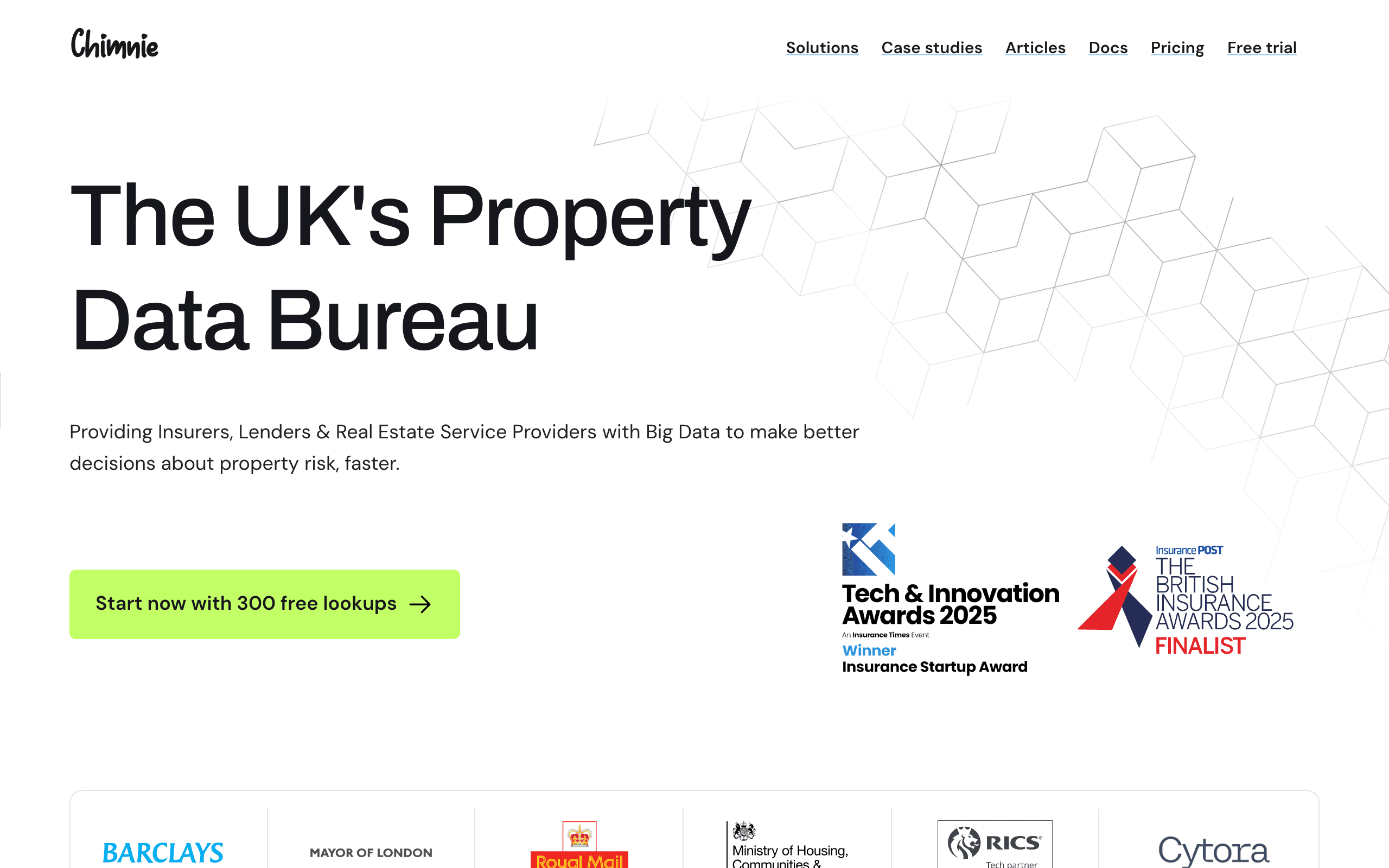
Chimnie property data API homepage
At Chimnie's premium tier, you're getting over three times the attribute count of Cotality's 135 data points, at a published per-lookup price, with no minimum commitment. For high-volume enrichment workflows, the unit economics are hard to argue with.
Where Cotality is stronger
Institutional entrenchment. 80%+ of UK BTL lenders, 86% of panel managers, 95%+ of surveying instructions. When your whole industry already runs on a platform, switching costs are real and the incumbent advantage is structural.
Surveying workflow. Nobody else controls the lender-to-surveyor pipeline the way Cotality does. If panel management is your use case, there's effectively one choice.
Long-horizon climate risk. The 30-year environmental forecasting models are genuinely differentiated. For portfolio-level climate exposure modelling, Cotality's depth is ahead.
Global coverage. If you need property data across the US, Australia, and Europe from one vendor, Cotality can do that. Chimnie covers the UK only.
Retrofit coordination. First-mover advantage in energy efficiency workflow tools for landlords and mortgage back-book reporting.
Where Chimnie is stronger
UK attribute depth. Over 500 attributes per property versus 135. For underwriting models, risk engines, and any workflow where feature density drives output quality, the difference is material.
Transparent pricing. Published rates from £0.05 per lookup, no minimum commitment, no procurement cycle. You can test and go live in days.
Free AVM. Evaluate without a contract. Run valuations on every case rather than reserving them for exceptions. The listing-versus-sale-price modelling adds a layer that standard AVMs miss.
Planning permission data. The only full UK planning dataset available from a single API - launching imminently after two years of national ingestion.
Commercial property. The UKCPD covers both residential and commercial from one integration.
Consumer feedback loop. 150,000+ users on chimnie.co.uk continuously validate the data, catching errors that purely algorithmic QA misses.
AI training data. Over one billion property images and structured datasets built for machine learning pipelines - a distinct product line that Cotality doesn't offer.
Speed. Public API docs, self-serve onboarding, days-not-months integration. For fintechs and startups building against deadlines, this is often the deciding factor.
Who should choose which
Choose Cotality if you're a large lender or insurer already embedded in its ecosystem, if surveying panel management is your core workflow, or if you need global property data from a single vendor. Its institutional market share means that for many organisations, Cotality is already baked into the infrastructure - and when something already works, there needs to be a compelling reason to change.
Choose Chimnie if the UK is your primary market and you need depth over breadth. Insurers building pricing models, MGAs looking for granular risk data, mortgage brokers wanting a free AVM on every case, and proptech firms needing hundreds of features at a predictable cost per lookup will get more from Chimnie's data. The commercial database, planning permission data, and published pricing make it the faster path from evaluation to production.
Consider running both if you're a large UK insurer or lender that needs Cotality's surveying workflow and institutional AVM alongside Chimnie's attribute depth and risk data as a supplementary enrichment layer. At £0.05 to £0.15 per lookup, running Chimnie alongside an existing Cotality relationship is a low-cost way to fill attribute gaps without disrupting established workflows.
Conclusion
Cotality is the infrastructure incumbent. It doesn't need to sell you on its data - in many UK lending and surveying workflows, you're already using it whether you realise it or not. That market position is earned and defensible.
Chimnie is the specialist challenger. It's built specifically for UK property data consumers who need granular attributes, transparent pricing, and fast integration - and it goes deeper on per-property detail than Cotality's 135 data points can match.
The honest answer for most UK property data buyers isn't either/or - it's understanding which provider fits which part of your workflow. For panel management and institutional AVM, Cotality is the default. For attribute-rich enrichment, risk scoring, commercial data, planning intelligence, and cost-efficient high-volume lookups, Chimnie is the stronger choice. The right question isn't which platform is better - it's which combination gives you the most complete picture of every property you touch.