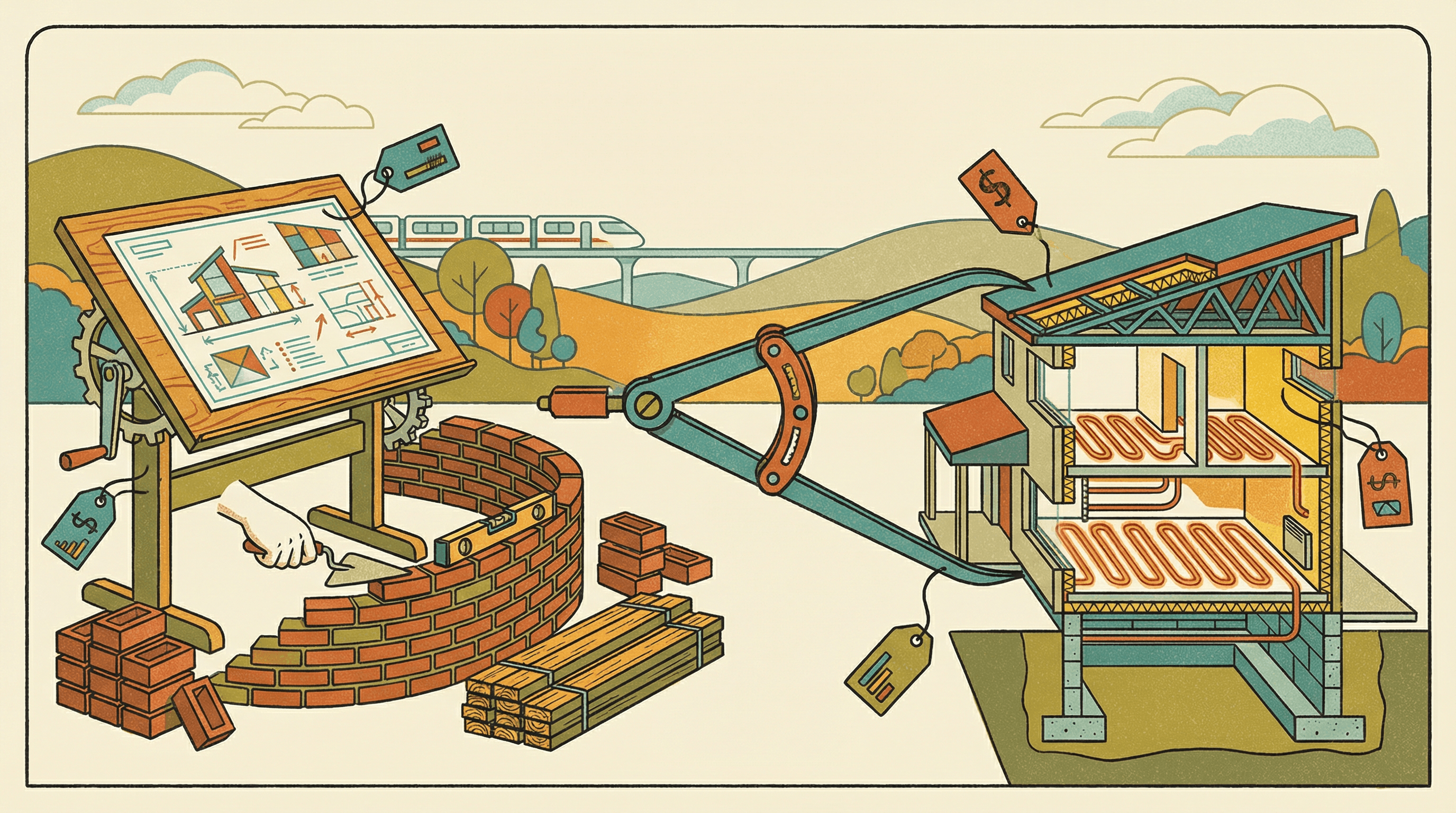
Chimnie and BCIS both provide rebuild cost data for UK properties, but they come from very different backgrounds and serve different parts of the value chain. BCIS is the construction industry's standard reference for building costs, maintained by RICS for over 60 years. Chimnie is a modern property data API that includes rebuild cost estimates alongside 500-plus other property attributes.
This comparison is based on publicly available product and pricing information. It's intended for insurers, surveyors, and property professionals evaluating their options for rebuild cost data.
Who is BCIS?
BCIS (Building Cost Information Service) is operated by RICS (Royal Institution of Chartered Surveyors) and has been the UK construction industry's primary source of cost data since the early 1960s. Over 4,000 organisations subscribe to BCIS products.
The product line is structured around three main platforms. BCIS CapX provides capital expenditure cost data for construction projects - cost analyses, elemental benchmarks, location factors, and price indices for every stage from appraisal to end of life. BCIS OpX covers operational costs - maintenance, lifecycle costing, component costs, and facilities management benchmarks. BCIS ProtX is the insurance-focused product, providing reinstatement cost estimates for residential and commercial properties.
BCIS ProtX is the product most directly comparable to Chimnie's rebuild cost data. It offers a calculator tool for assessing reinstatement costs on residential houses, purpose-built flats, and converted flats. The tool accounts for property age (Georgian to present day), location, specific property features, and current Building Regulations. It produces PDF reports and includes access to the ABI/BCIS House Rebuilding Cost Index.
BCIS pricing is not published on its website. Access is subscription-based, typically requiring an annual commitment. For individual RICS members, individual subscriptions are available. For insurance companies and larger organisations, pricing is negotiated - understood to start from several thousand pounds per year for platform access, with the actual per-lookup cost depending on the subscription tier and volume.
BCIS is the industry standard. Its data is referenced in insurance policy wordings, RICS guidance notes, and ABI (Association of British Insurers) publications. When a surveyor produces a reinstatement valuation, they're typically referencing BCIS data either directly or indirectly.
BCIS website homepage screenshot
Who is Chimnie?
Chimnie was founded by Jon Francis, a former data scientist from Google's innovation team, with the goal of making UK property data more transparent and accessible. The platform covers 35 million-plus UK residential properties and returns over 500 attributes per property through a documented REST API.
Chimnie's rebuild cost estimates include confidence intervals, finish-quality segmentation (which accounts for different build specifications), and decomposed materials and labour breakdowns at regional level. These estimates are delivered as data points within the broader property data response, alongside EPC data, flood risk, planning permissions, AVM valuations, and other attributes.
Chimnie processes around 30 million virtual property assessments each month. Its commercial API starts at £0.45 per property on a pay-as-you-go basis, with ratecard volume discounts available. Residential lookups are priced from £0.05 to £0.15 per property.
Feature comparison
Rebuild cost methodology
BCIS rebuild costs are derived from actual construction cost analyses collected from real projects over six decades. The data is adjusted for location (using BCIS location factors), building type, age, and specification. This empirical basis, grounded in observed construction costs rather than modelled estimates, is what gives BCIS its authority.
Chimnie's rebuild cost model is algorithmic - built from property characteristics, regional labour and materials cost data, and statistical modelling. It produces estimates with confidence intervals that quantify the uncertainty range. The finish-quality segmentation accounts for the difference between a basic specification and a high-end refurbishment.
The methodological difference matters. BCIS costs are backed by project-level evidence that has been collected, verified, and analysed by quantity surveyors. Chimnie's model can produce estimates at much greater scale and speed but relies on the model's accuracy rather than direct observation.
Scope of rebuild cost data
BCIS ProtX covers residential houses, purpose-built flats, and converted flats. BCIS CapX extends to commercial and specialist properties, covering essentially every building type in the UK.
Chimnie's rebuild cost estimates focus on residential properties. For commercial rebuild costs, BCIS remains the primary reference.
Beyond rebuild costs
This is where the comparison shifts dramatically. BCIS is a construction cost data provider. Its products are about building costs - new build, refurbishment, reinstatement, maintenance, and lifecycle.
Chimnie is a property data platform. Rebuild costs are one of 500-plus attributes returned per property. The same API call returns EPC data, flood risk, subsidence, pollution, crime, listed building status, conservation areas, roof condition, outbuildings, AVM valuations, planning permissions, and structural characteristics.
For an insurer underwriting a home insurance policy, the rebuild cost is one input among many. Flood risk, subsidence exposure, roof type, and property value all affect the premium. BCIS provides the rebuild cost. Chimnie provides the rebuild cost plus everything else.
Automated valuation model (AVM)
Chimnie provides a free AVM with UPRN-based lookups. BCIS doesn't offer property valuations - it's focused on replacement cost, not market value.
Insurance-specific data
Chimnie's data set is designed around insurance use cases. Rebuild costs, flood risk, subsidence, roof condition, outbuilding mapping, and property characteristics are all delivered in a format designed for underwriting models.
BCIS provides rebuild cost data and the ABI/BCIS House Rebuilding Cost Index. It doesn't provide the broader property risk data that insurers need for pricing.
Delivery and integration
BCIS delivers data through its web-based platform (CapX, OpX, ProtX), with PDF report downloads and some API access for larger subscribers. The platform is designed for individual lookups by surveyors, quantity surveyors, and insurance professionals.
Chimnie delivers everything via REST API, designed for automated pipelines. Structured JSON responses, bulk queries, and documented endpoints make it practical for integration into underwriting systems, quote engines, and claims platforms.
Location factors and indices
BCIS maintains location factors for adjusting construction costs across different UK regions - a critical tool for surveyors and quantity surveyors. It also publishes the Tender Price Index, General Building Cost Index, and other construction industry benchmarks.
Chimnie's rebuild costs are already adjusted for regional variation in materials and labour costs, so separate location factors aren't needed. But Chimnie doesn't publish the underlying indices and benchmarks that construction professionals rely on for project-level work.
Pricing and access
BCIS pricing is subscription-based and not publicly listed. Annual subscriptions for ProtX are understood to start from approximately £500 to £1,000 for individual RICS members, with organisational subscriptions running significantly higher. Large insurers running thousands of lookups daily will negotiate bespoke pricing.
Chimnie's pricing is published. Commercial lookups are £0.45 per property PAYG, residential from £0.05 to £0.15 per property. Rebuild cost data is included in the standard property response - it's not a separate product or additional charge.
For a surveyor running 10 reinstatement valuations a week, a BCIS ProtX subscription makes sense. For an insurance platform processing 10,000 quotes a day, Chimnie's per-property pricing with rebuild costs included alongside all other data points changes the economics entirely.
Where BCIS is stronger
BCIS is the industry standard for construction cost data, and standards matter. When a RICS surveyor produces a reinstatement valuation for a mortgage lender or insurance company, BCIS data carries authority that newer alternatives haven't yet established.
The depth of construction cost data in BCIS CapX is unmatched. Elemental cost breakdowns, project-level analyses, tender price trends, and maintenance benchmarks serve the quantity surveying and construction consultancy professions in ways that Chimnie doesn't attempt to.
For commercial and specialist property reinstatement costs, BCIS is the only practical option. Chimnie's rebuild cost models focus on residential.
BCIS's 60-year track record of collecting and verifying construction cost data from real projects provides an empirical foundation. The data has been tested against actual rebuild costs across thousands of projects. Chimnie's model is newer and hasn't been subject to the same scale of real-world validation.
The ABI/BCIS House Rebuilding Cost Index is referenced in insurance policy wordings and regulatory guidance. This institutional acceptance creates a network effect where BCIS data is used because BCIS data is what everyone else uses.
For individual RICS surveyors conducting one-off reinstatement assessments, BCIS ProtX is purpose-built. The calculator tool, PDF reports, and Building Regulations compliance checking are designed for that workflow.
Where Chimnie is stronger
Chimnie wins when rebuild cost data needs to be part of an automated, high-volume workflow rather than a manual, one-at-a-time assessment.
The pricing difference is stark for volume users. At £0.45 per property (or less with volume discounts), Chimnie delivers rebuild cost estimates alongside 500-plus other property attributes. A BCIS subscription that supports equivalent volume would cost significantly more.
The API delivery model makes Chimnie practical for integration into underwriting engines, quote platforms, and portfolio monitoring systems. An insurer running rebuild cost estimates on every policy in a book of business needs programmatic access, not a web calculator.
Rebuild costs with confidence intervals quantify the uncertainty in a way that single-point estimates don't. For pricing models that need to account for estimation risk, confidence intervals are genuinely useful.
Finish-quality segmentation addresses a real gap. The rebuild cost for a basic-specification property differs meaningfully from one with premium finishes. Chimnie's model accounts for this variation.
The combination of rebuild costs with flood risk, subsidence, EPC, planning permissions, AVM, and other property data in a single API call eliminates the need to stitch together data from multiple providers. BCIS gives you rebuild costs. Chimnie gives you everything an underwriter needs in one response.
For insurers moving towards automated, data-driven underwriting, Chimnie's integrated approach is more practical than sourcing rebuild costs from BCIS and everything else from other providers.

Chimnie website homepage screenshot
Who should choose which
RICS surveyors conducting reinstatement valuations should use BCIS. The methodology is the professional standard, the reports are accepted by lenders and insurers, and the ProtX tool is built for that workflow.
Quantity surveyors and construction consultants need BCIS CapX for project costing, benchmarking, and tender analysis. Chimnie doesn't serve this market.
Insurers and MGAs building automated underwriting should evaluate Chimnie. Rebuild costs integrated with property risk data, AVM, and 500-plus attributes via API - all at per-property pricing - is more practical than separate BCIS subscriptions plus additional data providers.
Insurance aggregators and comparison platforms processing high volumes of quotes benefit from Chimnie's API model and per-lookup pricing.
Loss adjusters and claims handlers might use both - BCIS for detailed, defensible reinstatement assessments on individual claims, and Chimnie for portfolio-level rebuild cost monitoring and initial triaging.
Reinsurers modelling portfolio exposure across large books of business will find Chimnie's bulk API access and per-property pricing more practical for accumulation analysis.
Conclusion
BCIS and Chimnie serve different points in the rebuild cost workflow. BCIS is the professional standard - 60 years of collected construction cost data, institutional acceptance, and methodology that the industry trusts for formal valuations. It's the right choice for individual assessments, professional reporting, and commercial property.
Chimnie approaches rebuild costs differently - as one data point among many in an integrated property data response, delivered via API at scale. For automated underwriting, portfolio monitoring, and high-volume quote processing, this model is more practical and more economical.
The two aren't necessarily in competition. A large insurer might use BCIS for formal surveyor-conducted reinstatement assessments on high-value claims while running Chimnie's rebuild estimates across the entire portfolio for pricing and exposure monitoring. The question isn't which one is right - it's which one is right for each part of your workflow.