
AddressCloud and Chimnie both serve the UK insurance market with property risk data, but they've grown out of different ambitions. AddressCloud is an insurance geocoding specialist - built by an insurer, for insurers. Chimnie is a property data bureau that serves insurers alongside lenders, property services firms, and data science teams. The overlap is real on geocoding and peril scoring, but the scope, pricing model, and product depth diverge in ways that matter when you're choosing a provider.
This comparison draws on publicly available product documentation, published pricing, and direct experience with both platforms. It's written to help data and procurement teams work out which one fits.
Recent developments
September 2025: AddressCloud received private equity investment from London-based Kester Capital, marking its first external funding since founding in 2015. The investment is intended to accelerate organic growth, expand go-to-market capabilities, and support AddressCloud’s push into North American markets, where it launched its first product in March 2025 covering over 150 million properties across 20 natural hazards. The deal represents a significant shift from the founder-owned, bootstrapped model the company operated for its first decade.
Who is AddressCloud?
AddressCloud was founded in 2015 by Mark Varley, who'd previously worked at RSA Insurance and got frustrated with the poor geocoding software available to underwriting teams. He built a cloud-first solution specifically for insurance, and the company has remained bootstrapped and founder-owned ever since - no external venture funding, a team of roughly 15 people, and a business model funded entirely by revenue.
The platform handles geocoding, peril scoring, property pre-fill, and portfolio analysis. It processes over 80 million transactions per month, which tells you it's running at serious scale for enterprise insurers. The geocoding engine is custom-built from scratch on top of Ordnance Survey AddressBase Premium, delivering rooftop-level accuracy rather than the postcode-centroid approximations that cheaper providers rely on.
AddressCloud's client list includes RSA (as a strategic geocoding partner), Flood Re (as their official address matching and property intelligence partner), Compare the Market, Integra, and Eaton Gate. The Flood Re relationship is a particularly strong credibility signal - it means AddressCloud's geocoding is trusted by the scheme that backstops the UK's highest-risk flood properties.
Peril scoring covers flood (through a partnership with JBA Risk Management), subsidence, windstorm, fire, crime, and climate change indicators. The JBA flood data is worth highlighting - JBA is the industry standard for UK flood modelling, and AddressCloud's integration means insurers get building-level flood scores rather than zone-level approximations.
More recently, AddressCloud has been expanding globally using the Overture Maps Foundation's building data. They've processed flood scores for 300 million buildings worldwide, with two billion more in the pipeline, and they're developing wildfire, earthquake, volcano, and tropical cyclone scores for international markets. A US partnership with Smarty for address verification and a Sapiens integration for underwriting platforms both launched in 2025.
What AddressCloud doesn't do is stretch beyond insurance risk. There's no automated valuation model, no EPC or energy efficiency data, no sales transaction history, no rebuild cost estimates, and no commercial property database. Pricing isn't published - you'll need to go through an enterprise sales process to get a quote.
PropertyData property market analytics website screenshot
Who is Chimnie?
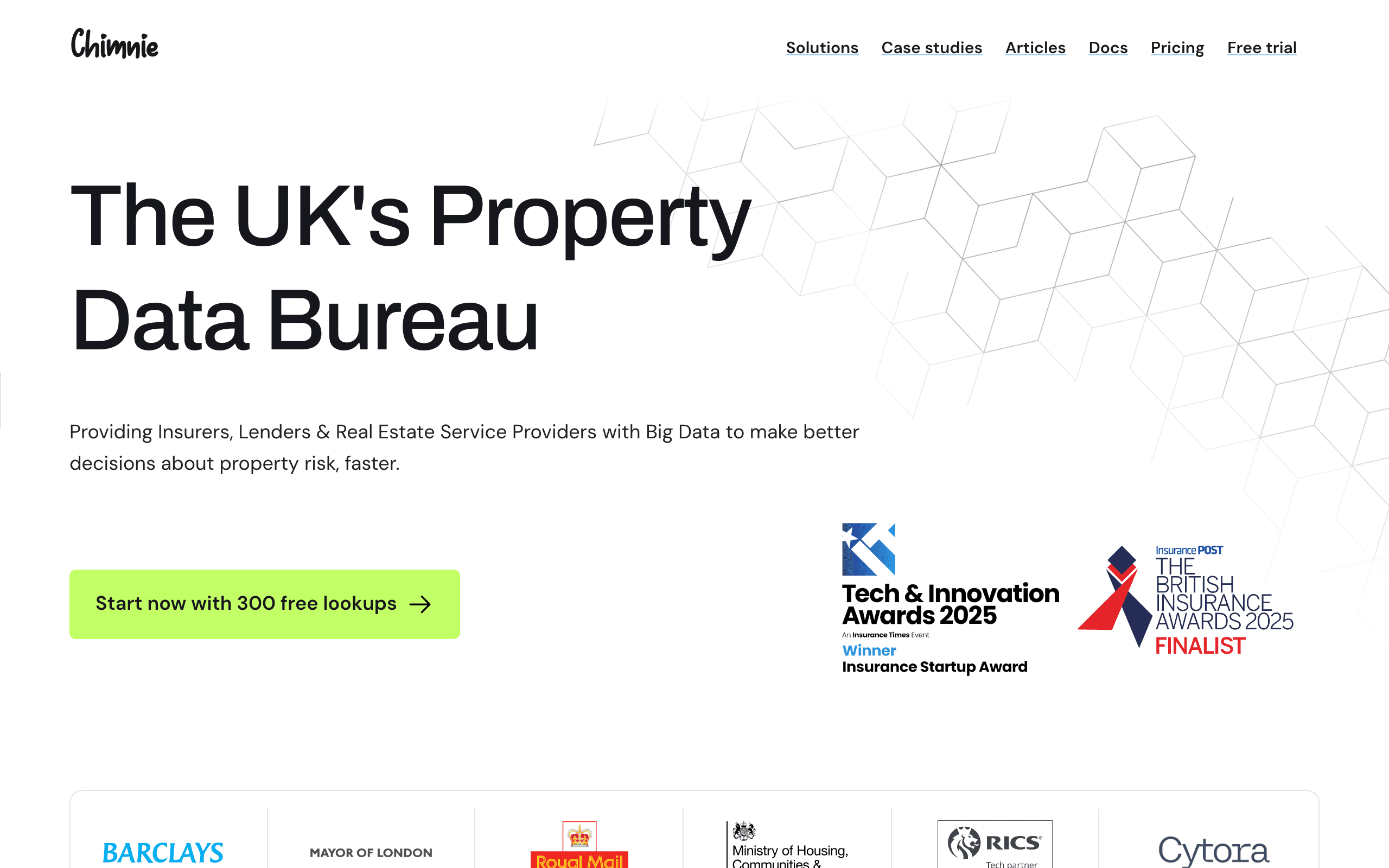
Chimnie was founded by Jon Francis, a former data scientist from Google's innovation team, with the goal of making UK property data more transparent and accessible. The company operates two platforms: chimnie.com, a B2B property data bureau serving insurers, lenders, and property services firms; and chimnie.co.uk, a free consumer research site with over 150,000 users whose feedback validates the underlying data at scale.
Chimnie processes around 30 million virtual property assessments each month, drawing on hundreds of geospatial, environmental, and proprietary datasets. Its product range includes the UK Residential Property Database, the UK Commercial Property Database, a free AVM, rebuild cost estimates, address autocomplete, risk scoring, and AI training data. Delivery is via API or flat file, with published pricing starting from less than one penny per lookup.
Feature comparison
Geocoding and address matching
Both platforms geocode against Ordnance Survey data and resolve to UPRN level. AddressCloud has made geocoding accuracy a central selling point - its engine is custom-built with fuzzy matching and configurable match-quality thresholds designed for insurance pricing, where a misplaced coordinate can shift a flood score from low to high risk. Chimnie's address autocomplete resolves to UPRN and feeds directly into property attribute lookups. AddressCloud's geocoding is battle-tested across 80 million monthly transactions for major insurance brands. That kind of throughput proves reliability at a scale few competitors can claim.
Peril and risk scoring
AddressCloud provides flood, subsidence, windstorm, fire, crime, and climate scores, with flood data sourced from JBA Risk Management - the industry benchmark for UK flood modelling. The scores are packaged for insurance underwriting workflows and tuned for pricing decisions.
Chimnie covers similar ground through its risk scoring product, drawing on environmental and geospatial datasets across dozens of perils including flood, subsidence, crime, pollution, traffic, tree-fall risk, and coastal erosion. The practical difference is context: AddressCloud's scores are designed to plug straight into underwriting systems, while Chimnie's are returned as part of a broader property data response that also includes physical attributes, valuation data, and planning history.
Property attributes
This is where the gap opens up. AddressCloud returns property characteristics - age, floor area, floor level, construction type, roof shape - enough to pre-fill a quote form. Chimnie's UKRPD returns over 500 attributes per property: construction type, roof material and condition (via satellite imagery), outbuildings, extensions, garden boundaries, solar panel detection, planning applications, EPC data, ownership history, micro-level house price indices, and more. If you need to understand the property itself rather than just the risk at its location, Chimnie carries significantly more data.
Valuations and rebuild costs
AddressCloud doesn't offer automated valuations or rebuild cost estimates. Chimnie provides a free AVM built on Bayesian hierarchical methods with calibrated confidence intervals, producing separate listing and sale price estimates at micro-postcode granularity. It also provides rebuild cost estimates with confidence intervals, finish-quality segmentation, and decomposed materials and labour breakdowns at regional level. For lenders running affordability checks or insurers setting sum-insured figures, this is a material gap in AddressCloud's offering.
Planning permission data
Chimnie is completing two years of national ingestion of planning permission data from every UK local authority, standardised into a consistent schema. This dataset is launching imminently and will cover extensions, conversions, and outbuildings that haven't yet triggered a new transaction or EPC - the kind of property changes that create blind spots in valuation and risk models. AddressCloud doesn't include planning permission data.
Commercial property
AddressCloud focuses on residential property. Chimnie's UKCPD extends coverage to offices, retail, warehouses, and mixed-use properties - useful for mixed-portfolio insurers or commercial lending teams.
Portfolio and accumulation management
AddressCloud has purpose-built tools for batch portfolio analysis - cleansing entire books with rooftop coordinates and peril scores, identifying risk hotspots, and comparing against national averages. This matters for insurers managing catastrophe exposure across large portfolios. Chimnie's data can feed external exposure models and batch enrichment workflows, but the dedicated portfolio aggregation tooling isn't built in.
EPC and energy data
Chimnie property data API homepage
Chimnie includes EPC data, energy performance metrics, and related attributes as part of its standard property response. AddressCloud doesn't return EPC or energy efficiency data. For insurers or lenders with green mortgage or retrofit requirements, this gap may matter.
Pricing
and access
AddressCloud operates on enterprise contracts with pricing disclosed during the sales process. Given it's bootstrapped and processing 80 million monthly transactions, the pricing is presumably competitive enough for high-volume insurers, but there's no way to evaluate costs without engaging sales.
Chimnie's residential pricing runs at £0.05 per property for Core, £0.10 for Plus, and £0.15 for Premium - with all 500+ attributes available at the top tier. Commercial lookups are £0.45 per property on PAYG, with ratecard volume discounts available. The full pricing is published openly, and the free AVM lets you test without a sales call.
Where AddressCloud is stronger
AddressCloud wins on insurance workflow integration and geocoding pedigree. The custom-built geocoding engine, processing 80 million transactions monthly for brands like RSA and Flood Re, is genuinely proven at enterprise scale. The JBA flood partnership means you're getting building-level flood scores from the UK's most respected flood modeller, not a derived approximation.
The portfolio analysis tools are built for the specific problem of catastrophe exposure management - batch cleansing, accumulation identification, and hotspot analysis. If your primary need is peril scoring tied to underwriting systems with portfolio-level aggregation alongside it, AddressCloud's focused approach means less configuration and a faster path to production.
The bootstrapped discipline behind AddressCloud deserves respect too. Building a profitable, sustainable business serving enterprise insurers without external funding says something about product-market fit and the team's ability to execute.
Where Chimnie is stronger
Chimnie's advantage is breadth, transparency, and cross-sector coverage. Over 500 property attributes, automated valuations, rebuild costs, EPC data, commercial property, planning history, and satellite-derived features give it a much wider data footprint. For any use case that extends beyond pure peril scoring - lending, proptech, portfolio analysis, or model training - Chimnie covers ground that AddressCloud simply doesn't.
The published pricing model and free AVM lower the barrier to evaluation. You can run a valuation, test the API, and check attribute coverage before talking to anyone. For smaller firms, startups, or teams that want to prototype before committing to an enterprise procurement cycle, this matters.
The consumer platform (chimnie.co.uk) creates a feedback loop that continuously validates data quality against real homeowner input. When 150,000 users check their own property details and flag inaccuracies, the data improves. This kind of crowd-validated quality assurance is something no other UK property data provider replicates at this scale.
The planning permission dataset, launching imminently after two years of national ingestion, will fill a gap that affects both valuations and risk models. Properties that have been extended, converted, or had outbuildings added without triggering a new EPC or transaction are invisible to most data providers. Chimnie's planning data will make them visible.
Who should choose which
Choose AddressCloud if your operation is insurance-only and your primary need is geocoding and peril scoring with tight underwriting system integration. If you need portfolio-level accumulation analysis and you value the JBA flood partnership and Flood Re endorsement, AddressCloud has built its product around exactly your workflow. You'll want a team comfortable with enterprise procurement and bespoke pricing.
Choose Chimnie if you need property data across insurance, lending, or property services. If valuations, rebuild costs, EPC data, commercial property, or deep property attributes matter to your workflow, Chimnie is the more complete dataset. Published pricing and API access make it straightforward to evaluate without a lengthy sales process. Start with the free AVM or check pricing to see the cost per lookup.
Consider both if you're a large insurer that needs AddressCloud's geocoding precision and portfolio tooling alongside Chimnie's richer property attribute data. The two aren't mutually exclusive - one handles geocoding and accumulation management, the other fills in the property detail, valuations, and rebuild costs.
Conclusion
AddressCloud and Chimnie solve different shapes of the same problem. AddressCloud is a specialist - narrow, deep, and well-suited to insurance teams that need rooftop-level geocoding and peril scoring without distraction. The Flood Re partnership, RSA relationship, and 80 million monthly transactions are genuine proof points. Chimnie is broader - more attributes, more use cases, more transparent pricing, and a consumer validation layer that keeps the data honest. The right choice depends on whether your workflow stops at risk scoring or extends into valuations, property detail, and cross-sector data needs.