
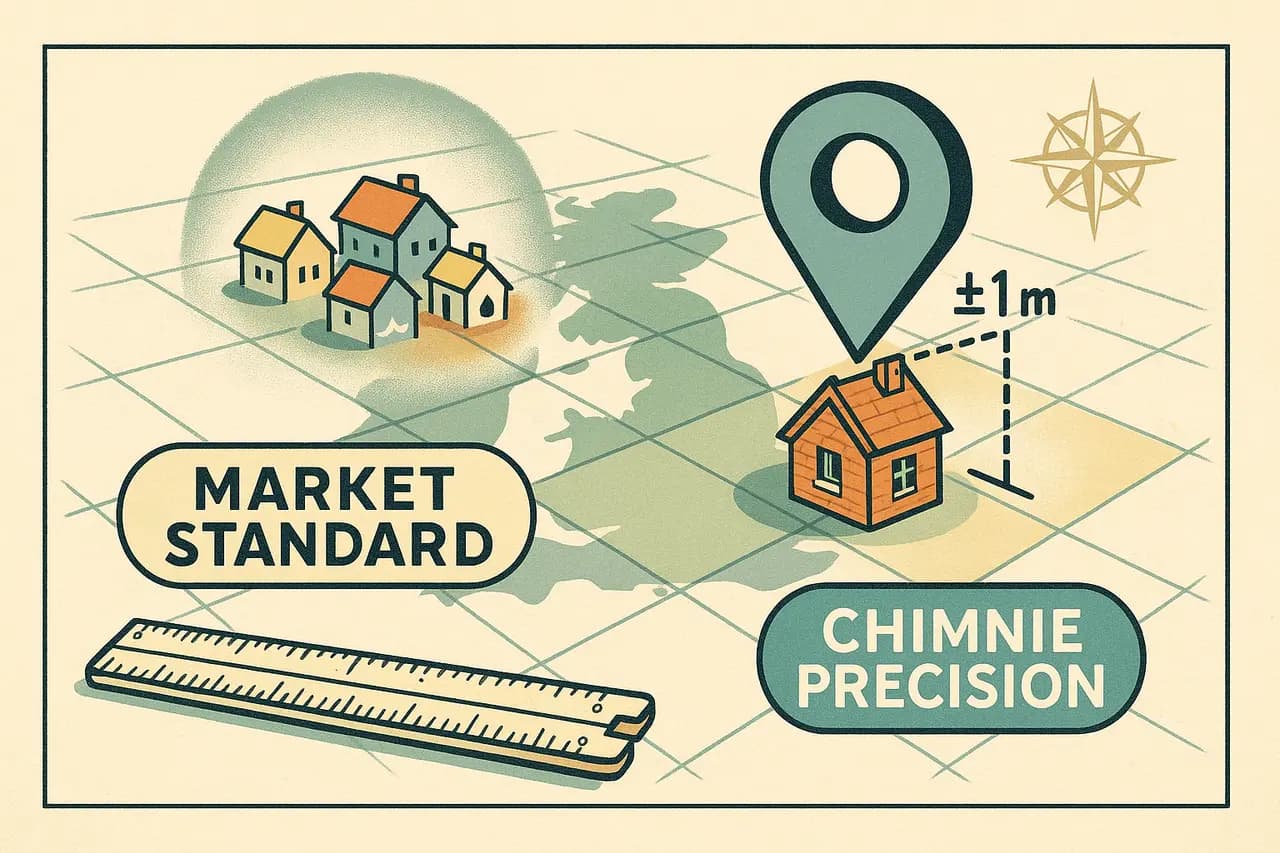
Geospatial Accuracy: The New Standard in Property Data Services
Geospatial accuracy is a critical factor in property data services, especially for insurers and lenders who rely on precise geographic information to assess risks, determine property values, and make informed decisions.
Traditional methods of geospatial analysis, like postcode-level data, often don't provide the nuanced detail needed to capture the true nature of location-based risks. Chimnie's use of advanced geospatial techniques — including high-resolution mapping and geospatial indexing — sets it apart in the market, offering a level of accuracy that genuinely improves risk modelling and decision-making.
The Limitations of Traditional Geospatial Analysis
Traditional geospatial analysis in property data typically involves broad geographic markers, such as postcodes or administrative boundaries. While these markers give a general sense of location, they often fail to capture the finer details that can significantly influence a property's risk profile.
Common limitations include:
Broad Generalisations: Postcode-level data groups properties within a large geographic area, potentially masking important differences in risk factors like flood zones, elevation, and proximity to environmental hazards.
Lack of Precision: Traditional geospatial analysis may not account for micro-level variations, such as slight changes in elevation or distance from a water body, leading to inaccuracies in risk assessments.
Static Mapping: Many traditional methods rely on static maps that don't reflect real-time changes in the environment — things like new developments, changes in land use, or evolving climate risks.
These limitations can result in risk assessments that are either overly cautious or insufficiently protective, leading to poor pricing strategies, underwriting decisions, and portfolio management.
Chimnie's Approach to Geospatial Accuracy
Chimnie addresses the shortcomings of traditional geospatial analysis by using advanced techniques to provide high-resolution, property-level geospatial data. Here's how we improve geospatial accuracy:
High-Resolution Mapping: We use high-resolution mapping technologies, including LiDAR (Light Detection and Ranging) and remote sensing, to create detailed topographic maps. This allows us to identify subtle variations like changes in elevation, terrain features, and vegetation cover — all crucial for accurate risk assessments.
Geospatial Indexing with H3: We use geospatial indexing systems like H3, an open-source system developed by Uber. H3 divides the world into a hexagonal grid, offering multi-resolution analysis that provides consistent and accurate spatial coverage. Unlike traditional postcode-level analysis, H3's hexagonal grid captures micro-level variations, allowing for a more precise assessment of location-based risks.
Integration with Property-Level Data: Our geospatial analysis isn't done in isolation. It's integrated with property-specific data — construction materials, historical flood records, and local infrastructure quality. This integration provides a full view of risk that goes well beyond just location.
Case Study: Improving Flood Risk Assessment with Geospatial Precision
Consider an insurer assessing flood risk for properties in a coastal town. Traditional postcode-level analysis might classify the entire postcode as high-risk, leading to uniformly high premiums for all properties within the area. But this broad assessment overlooks crucial variations — elevation differences, proximity to water bodies, and the presence of flood defences.
By using Chimnie's high-resolution mapping and H3 geospatial indexing, the insurer can perform a much more granular assessment. Our system divides the area into hexagonal cells, each reflecting localised variations in elevation, distance from water sources, and historical flood data.
This detailed analysis reveals that some properties, despite being within a high-risk postcode, are actually on elevated ground or behind newly installed flood barriers, reducing their actual flood risk. Armed with this precise information, the insurer can:
Adjust Premiums: Offer lower premiums to properties with reduced flood risk, providing more competitive pricing and attracting customers who'd otherwise be overcharged based on traditional risk models.
Refine Underwriting Criteria: Develop more nuanced underwriting criteria that consider the specific geospatial characteristics of each property, reducing the likelihood of unexpected claims and improving portfolio stability.
Improve Customer Satisfaction: Give policyholders fair and transparent premiums that accurately reflect their property's true risk level, building trust and loyalty.
Comparing Chimnie's Geospatial Accuracy to Market Alternatives
While several property data providers offer geospatial analysis services, Chimnie's approach stands out because of its focus on precision and integration. Here's how we compare to typical market alternatives:
Granularity: Many providers rely on postcode-level or administrative boundary-based assessments, which can miss important micro-level details. Our use of high-resolution mapping and hexagonal grid indexing provides a more granular view, capturing nuances that broad markers overlook.
Dynamic Data Integration: Some providers use static geospatial data that doesn't account for real-time environmental changes. Our integration of dynamic environmental data ensures that risk assessments are based on the most current conditions, providing a more accurate and relevant analysis.
Customisation and Flexibility: Chimnie's geospatial data can be tailored to suit the specific needs of insurers and lenders. Clients can access geospatial insights at various levels of resolution, from regional trends to individual property analysis, allowing for tailored risk assessments.
Strategic Benefits of Better Geospatial Accuracy
Our focus on geospatial accuracy offers several clear advantages for insurers and lenders:
Improved Risk Modelling: Better geospatial accuracy leads to more reliable risk models, reducing the likelihood of mispricing and unexpected losses.
Smarter Pricing Strategies: By accurately assessing location-based risks, organisations can set premiums and loan terms that reflect the true risk profile of each property, improving profitability.
Risk Mitigation: Precise geospatial data enables proactive risk mitigation strategies, such as identifying properties that may benefit from flood defences or other protective measures.
Conclusion: The Future of Geospatial Accuracy in Property Data Services
Geospatial accuracy is a cornerstone of effective risk assessment in the property market. Chimnie's use of advanced geospatial techniques — including high-resolution mapping, H3 indexing, and dynamic data integration — sets a new standard in the industry.
By providing insurers and lenders with precise, property-level geospatial insights, we improve risk modelling, sharpen pricing strategies, and support informed decision-making. In an environment where accurate risk assessment is crucial for success, Chimnie's commitment to geospatial accuracy offers a genuine competitive edge. By moving beyond traditional, broad-brush approaches to location-based risk analysis, we give our clients the tools to navigate the complexities of the property market with confidence and precision.
Other Articles



Put this data to work
Everything discussed here is available through the Chimnie API, with up to £16 of free balance to try it.